

 Français
 Español
 Deutsch

Content
- 1 What Is an Internal-External Thread Conversion Nut
- 2 How an Internal-External Thread Conversion Nut Works
- 3 Thread Types and Standard Size Coverage
- 4 Material Options and Comparative Performance
- 5 Load Capacity and Thread Engagement Design
- 6 Typical Application Scenarios Across Industries
- 7 Material and Environment Compatibility
- 8 Installation Guidance
- 9 Thread Adapter Nut vs Standard Single-Thread Nut
- 10 OEM and ODM Customization Capability
- 11 About Dongtai Jinzhize Metal Products Co., Ltd.
- 12 Frequently Asked Questions
- 12.1 Q1What is the difference between an internal-external thread conversion nut and a helical wire insert
- 12.2 Q2Can a thread adapter nut convert metric threads to imperial threads
- 12.3 Q3Which material is generally suited to outdoor or corrosive environments
- 12.4 Q4What information is needed to request a custom thread reducer nut
- 12.5 Q5How deep should the base hole be tapped for a double thread nut
- 12.6 Q6Does Dongtai Jinzhize Metal Products Co., Ltd. support large volume orders
What Is an Internal-External Thread Conversion Nut
An internal-external thread conversion nut is a small cylindrical fastener that carries two different thread forms on a single body: an external thread on its outer wall and an internal thread running through its bore. It is installed into a pre-tapped or pre-drilled hole using the external thread, and once seated, the internal thread accepts a bolt, stud, or screw of a different size or thread standard. This component is also commonly referred to as a thread adapter nut, a double thread nut, or a thread reducer nut, and all of these terms describe the same basic function of bridging two different thread specifications within one part.
In practical terms, a threaded adapter of this kind allows a hole that was originally sized for one fastener to safely accept a different fastener, without machining a new hole or altering the surrounding structure. This is particularly useful when equipment uses mixed metric and imperial hardware, when an original hole has become worn or damaged, or when a design change requires a smaller or larger bolt to be fitted into an existing mounting point. Because the conversion nut standardizes the resulting thread, it also supports interchangeability across assemblies that would otherwise require custom-machined parts.
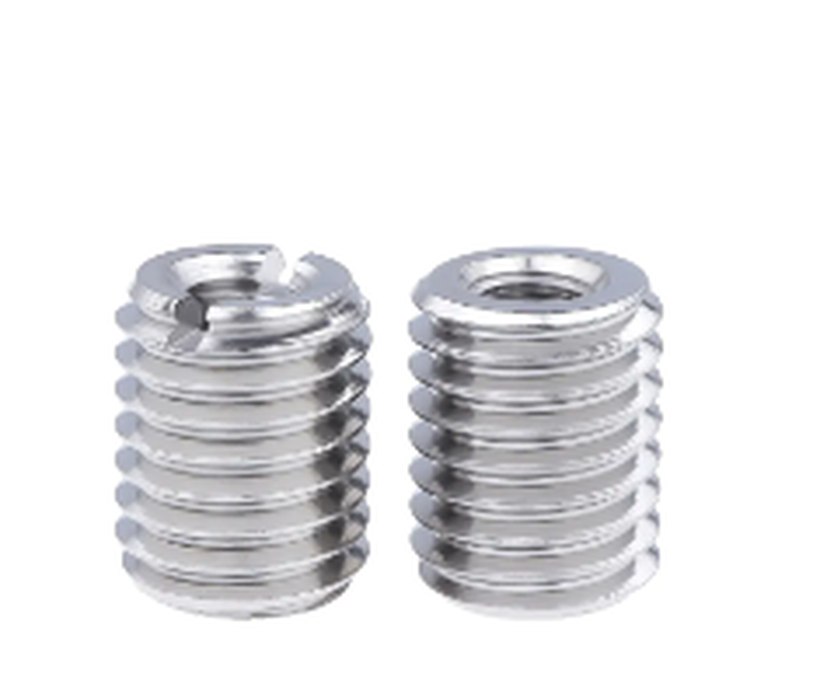
The photograph above shows a stainless steel internal-external thread conversion nut produced in two configurations. The part on the left includes a slotted top, which allows the nut to be driven with a flat blade tool during installation, while the part on the right uses a plain bore top and is typically driven with an internal hex key or a dedicated installation tap. Both parts share the same fundamental structure: a helical external thread on the outer surface for anchoring into the base hole, and a separate internal thread inside the bore that receives the mating fastener. Conversion nuts of this type are manufactured from carbon steel, stainless steel, or brass, with stainless steel commonly selected for applications where corrosion resistance is a priority.
Internal-external thread conversion nuts, double thread nuts, and threaded adapters of this general design are widely applied wherever the thread already present in a hole does not match the fastener that needs to be installed, including machinery assembly, automotive component mounting, equipment maintenance, and the general repair of worn or damaged threaded holes.
How an Internal-External Thread Conversion Nut Works
The working principle of a thread adapter nut is straightforward once the two thread systems are separated conceptually. The external thread engages the base material, whether that is a pre-tapped metal hole, a threaded boss, or a mating fixture, and it is this outer thread that determines how the nut is retained in the surrounding structure. The internal thread engages the incoming fastener, and this inner thread is selected independently of the outer thread, which is exactly what allows the part to convert between two different sizes or standards. Between installation and final use, torque is transferred through the body of the nut itself, so the wall thickness and material selection both influence how much load the assembly can carry.
During installation, the external thread is driven into the base hole to a specified depth, after which the internal bore is ready to receive the mating bolt or screw. The isometric illustration below marks the main structural features of a typical internal-external thread conversion nut, including the external thread body, the internal threaded bore, the overall length, and the outer diameter, which together define how the part is specified and ordered.
As the isometric diagram shows, the external thread and the internal thread are functionally separate even though they share the same body, which is the core design idea behind every internal-external thread conversion nut, double thread nut, and threaded adapter. The overall length and outer diameter are the two dimensions most often used to specify a part, since they determine whether the nut will physically fit within the available hole depth and bore clearance. The drive feature, whether a slot or an internal hex, only affects how the part is installed and does not influence its load-carrying behavior once seated. Wall thickness between the internal bore and the external thread root is another factor that installers should be aware of, because a thinner wall generally reduces the torque the part can safely withstand during installation. Understanding this two-thread structure makes it easier to select the correct size when converting between metric and imperial hardware, which is covered in the next section.
Thread Types and Standard Size Coverage
Every internal-external thread conversion nut is defined by two separate thread callouts, one for the external thread and one for the internal thread, and each of these can independently follow either the metric system or the unified inch system. A metric to imperial thread adapter nut is simply a part where the external thread follows one system, commonly metric, while the internal thread follows the other, commonly unified coarse or unified fine. This flexibility is what makes double thread nuts useful in facilities that maintain both metric and imperial equipment side by side.
Within the metric system, threads are described by the ISO 261 general purpose standard, which defines nominal diameters and their associated coarse and fine pitch series. Within the inch based system, the Unified Coarse (UNC) and Unified Fine (UNF) series defined in ASME B1.1 remain the most widely referenced designations across North American machinery and automotive applications. Internal-external thread conversion nuts are typically produced to cover a nominal range from around M3 up to M30 on the metric side, with a comparable range available in unified coarse and unified fine designations, which allows a single product family to serve a broad span of hole sizes without custom tooling.
| Standard System | Typical Designation Range | Pitch Series | Reference Standard |
|---|---|---|---|
| Metric (ISO) | M3 to M30 | Coarse and fine | ISO 261 / ISO 965 |
| Unified Coarse (UNC) | No.4-40 to 1 1/4-7 | Coarse | ASME B1.1 |
| Unified Fine (UNF) | No.4-48 to 1 1/4-12 | Fine | ASME B1.1 |
When specifying a thread adapter nut supplier or requesting a custom thread reducer nut, it is generally good practice to confirm both the external and internal thread callouts separately, along with the pitch series, rather than assuming a single size designation covers both threads. This avoids mismatches during assembly and shortens the sourcing process for engineering and procurement teams.
Material Options and Comparative Performance
Internal-external thread conversion nuts are commonly produced in three base materials: carbon steel, stainless steel, and brass, and the choice between them generally comes down to the balance of strength, corrosion resistance, and temperature tolerance required by the application. Carbon steel offers strong general mechanical performance and is often used for standard machinery assembly where the operating environment is dry and controlled. Stainless steel trades a small amount of raw strength for meaningfully better corrosion resistance, which is why a stainless steel thread conversion nut is frequently specified for outdoor equipment, marine adjacent environments, or components exposed to washdown and humidity. Brass provides good machinability and useful electrical and thermal conductivity, and it is often selected for electronics housings or precision instruments where galling resistance and non magnetic properties matter more than peak strength.
The chart below presents a relative comparison of these three materials across three performance dimensions on a general zero to ten scale. The values are illustrative and intended to reflect widely recognized material property relationships rather than results from a single laboratory test report, so they should be used as a general planning reference rather than an exact specification.
As the chart illustrates, carbon steel and stainless steel both score highly on tensile strength, which explains why both are common choices for load bearing machinery joints. Stainless steel shows a clear advantage in corrosion resistance, consistent with its widespread use as a stainless steel thread conversion nut in humid or outdoor settings. Brass trails slightly on raw tensile strength but remains a practical option where machinability and non magnetic behavior are more important than peak load capacity. Temperature tolerance follows a similar pattern, with stainless steel generally maintaining mechanical properties across a wider range than brass. None of these differences make one material universally superior, and the correct choice depends on matching the material to the specific mechanical and environmental demands of the assembly.
Load Capacity and Thread Engagement Design
The amount of load a thread adapter nut can transfer before the threads strip or pull out is closely tied to how much thread engagement length is available, meaning how deep the external thread is seated into the base hole. General fastener design references, including guidance widely documented in resources such as Machinery's Handbook, indicate that pull-out strength increases quickly as engagement length grows from a shallow depth and then levels off once engagement reaches roughly one and a half to two times the nominal diameter. Beyond that point, additional depth contributes comparatively little extra holding strength, since the outer threads nearest the entrance of the hole carry a disproportionate share of the load.
This relationship is a general engineering principle rather than a fixed number for every part, because actual performance also depends on base material hardness, thread fit class, and installation quality. Even so, the trend shown below is a useful planning reference when deciding how deep a hole should be tapped to accept a given conversion nut, particularly for a heavy duty double thread nut for machinery where the joint will see repeated loading.
The curve rises sharply between shallow engagement and roughly one times the nominal diameter, which is the region where most of the usable holding strength is gained. Between one and two times the diameter, the curve continues climbing but at a slower rate, showing diminishing returns as engagement depth increases further. Beyond approximately two times the diameter, the trend flattens, indicating that additional hole depth adds little practical benefit for most standard applications. This pattern is consistent with general thread mechanics, where the first several engaged threads carry a larger share of the axial load than the threads further down the hole. For engineers specifying a custom thread reducer nut OEM part, this trend supports selecting an engagement length in the one and a half to two diameter range as a reasonable general target for balanced strength without excessive hole depth.
Typical Application Scenarios Across Industries
Internal-external thread conversion nuts and double thread nuts appear across a wide range of industrial settings, and the four categories below represent the general areas where these industrial thread conversion components are most frequently specified. Automotive assembly remains one of the largest application areas, covering engine components, transmission housings, and chassis mounting points where mixed thread standards are common across different vehicle platforms. General machinery follows closely, where thread adapter nuts are used both in original assembly and in field repair of stripped or damaged holes. Aerospace and rail applications tend to demand tighter material traceability and consistency, while hydraulic systems and other specialized equipment round out the remaining share.
The chart below presents a general, illustrative breakdown of these application categories, intended to reflect broadly observed usage patterns across the threaded fastener sector rather than figures drawn from one specific market study.
Automotive and general machinery together account for the majority share in this illustrative breakdown, which lines up with the fact that both sectors combine high assembly volumes with a frequent need to reconcile metric and imperial hardware on the same production line. Aerospace and rail applications make up a smaller but still meaningful share, and these industries typically place additional emphasis on material traceability and documented quality control given the safety critical nature of the assemblies involved. Hydraulic and other specialized equipment represents the remaining portion, where conversion nuts are often used to adapt fitting ports or repair threaded connections on pumps and manifolds. The relative sizes of these segments can shift depending on regional industrial composition, so readers should treat the chart as a general orientation rather than a precise market measurement. Even so, the pattern is useful for understanding why industrial thread conversion components are engineered to serve several sectors at once rather than a single narrow use case.
Material and Environment Compatibility
Choosing the right material for a given operating environment is one of the most practical decisions when sourcing a double thread nut manufacturer for a specific project. The heatmap below summarizes general suitability across four common environments, with darker shading representing a stronger general fit based on well established material characteristics rather than a formal test matrix. This kind of comparison is useful during early design review, before a final specification is locked in, since it highlights which material family is worth evaluating first for a given environment.
Carbon steel shows a strong fit for general machinery, where the environment is typically dry and controlled, but its suitability drops in marine or corrosive settings without additional plating or coating. Stainless steel maintains a high suitability rating across most environments, which is why it appears so frequently in the specifications for internal-external thread conversion nuts used outdoors or in washdown areas. Brass is generally well suited to electronics and precision instrument contexts, where its non magnetic behavior and conductivity are more valuable than raw strength, while its corrosion resistance sits between carbon steel and stainless steel in general industrial settings. These patterns are grounded in well documented material science rather than proprietary data, and they are intended as a starting point for material screening rather than a substitute for environment specific engineering review. Buyers evaluating a thread adapter nut supplier for a new program often use a simple fit matrix like this one to shortlist candidate materials before requesting detailed mechanical data.
Installation Guidance
Installing an internal-external thread conversion nut correctly has a direct effect on how well the finished joint performs, and the general sequence below reflects common practice for slotted and non-slotted variants alike. Preparation of the base hole is the step most likely to affect final performance, since an undersized or misaligned pilot hole can lead to cross threading during installation. The steps are presented in a typical order, though specific products may include additional guidance from the supplier for unusual base materials or high vibration environments.
- Confirm the external thread size against the tapped hole and the internal thread size against the fastener that will be installed, checking both the diameter and the pitch series.
- Inspect the pilot hole for cleanliness, removing any chips, oil, or debris that could interfere with full thread engagement.
- Apply a thread locking compound if the application involves vibration or repeated load cycling, following the compound manufacturer's instructions for cure time.
- Drive the conversion nut into the hole using the appropriate tool, whether a flat driver for a slotted part or a hex key or installation tap for a non-slotted part, keeping the tool aligned with the hole axis.
- Seat the nut to the specified depth, generally flush with or slightly below the surrounding surface unless the design calls for a specific standoff.
- Verify the internal thread is clear and undamaged before installing the mating bolt, stud, or screw, then tighten to the torque value appropriate for the internal thread size and material.
Skipping the hole preparation step is one of the more common sources of installation problems, since debris left in the hole can prevent the external thread from seating fully and reduce the effective engagement length discussed earlier in this article. For repeated production use, many assembly teams standardize on a specific driving tool and torque setting for each conversion nut size, which helps maintain consistent results across an assembly line.
Thread Adapter Nut vs Standard Single-Thread Nut
It is worth distinguishing an internal-external thread conversion nut from an ordinary single-thread nut, since the two parts solve different problems even though they may look similar at first glance. A standard nut carries only one thread size and is designed to secure a bolt of matching specification, while a conversion nut, double nut, or thread reducer nut carries two independent thread callouts on the same body. The table below summarizes the main functional differences between the two part types.
| Feature | Standard Single-Thread Nut | Internal-External Thread Conversion Nut |
|---|---|---|
| Thread Configuration | One thread size only | Two independent thread sizes on one body |
| Primary Function | Secures a bolt of matching thread | Converts between two different thread standards or sizes |
| Typical Use Case | New assembly with matching hardware | Mixed metric and imperial hardware, thread repair, size adaptation |
| Installation Method | Threaded onto a bolt or stud | Driven into a pre-tapped hole, then receives a separate fastener |
| Material Options | Carbon steel, stainless steel, brass | Carbon steel, stainless steel, brass, matched to environment |
This distinction matters most during procurement, since specifying a standard nut when a conversion function is actually needed will not solve a mismatched thread problem. Engineers and buyers sourcing a thread adapter nut supplier should clearly state that a dual-thread part is required, along with both thread callouts, to avoid delays during quoting and sampling.
OEM and ODM Customization Capability
Beyond standard catalog sizes, many procurement teams require a custom thread reducer nut OEM part built to a specific drawing, with a non-standard combination of internal and external threads, a modified overall length, or a specific surface finish. Custom development of this kind generally requires a manufacturer with in-house tooling capability, automated production equipment, and a quality system that can hold tight dimensional tolerances across large production volumes. This is particularly relevant for automotive and aerospace programs, where documentation and part traceability are often required alongside the physical hardware itself.
Production Scale and Quality Management
As demand for standardized threaded connection components continues to grow across the automotive and general machinery sectors, manufacturers that combine engineering support with automated production capacity are increasingly relied upon for both standard and custom parts. A facility equipped with hundreds of machine tools and automated production lines can typically move from sample approval to volume production more efficiently than a smaller job shop, which is an important consideration for OEM programs with defined delivery schedules. Consistent process control across every production batch is what ultimately supports traceable, repeatable part quality, which matters as much for a double thread nut manufacturer as it does for any other precision fastener supplier.
About Dongtai Jinzhize Metal Products Co., Ltd.
Dongtai Jinzhize Metal Products Co., Ltd. is a specialized manufacturing facility dedicated to threaded connection products for the automotive and aerospace sectors. The company primarily produces Helical Wire Inserts, Self-Tapping Inserts, Key Locking Inserts, Threaded Adapters, and Oil Plugs, along with matching installation taps and tools, which places internal-external thread conversion nuts and related threaded adapters directly within its core product range rather than as a peripheral offering.
Established in 2015, the company operates from a 10,000 square meter owned manufacturing plant equipped with hundreds of machine tools and automated production systems. Through years of development, the company has built an experienced team of design, development, and production specialists, supported by a structured quality management system and a comprehensive after-sales service mechanism. With an annual output value of 153 million RMB in 2024, the company maintains the capability for large-scale, stable supply to customers who require consistent volumes over extended production runs.
The company's products are widely utilized across the automotive industry, including engines and transmissions for both passenger and commercial vehicles, as well as the aerospace industry and rail vehicle manufacturing. This spread of end markets requires the company to maintain consistent, traceable production records across different product lines, since automotive and aerospace customers commonly request documentation alongside the physical parts they purchase.
Related Threaded Connection Products
In addition to internal-external thread conversion nuts, the company also manufactures helical wire inserts, which are precision embedded fasteners made from high-strength, high-elasticity cold-rolled stainless steel wire, coiled into a diamond-shaped cross section. These inserts are screwed into a pre-tapped hole to form a durable, wear-resistant standard internal thread, and they are primarily used in lower-strength base materials such as aluminum, magnesium alloys, plastics, and wood, or to repair damaged threads in cast iron and steel components. Together with self-tapping inserts, key locking inserts, and oil plugs, these product lines allow the company to support a broad range of threaded connection requirements for customers working across automotive, aerospace, marine, precision machinery, and electronics applications.
Frequently Asked Questions
Q1What is the difference between an internal-external thread conversion nut and a helical wire insert
An internal-external thread conversion nut is a solid body carrying two separate thread callouts on one part, while a helical wire insert is a coiled wire form installed into a tapped hole to reinforce or repair a thread of the same nominal size. The two components are related but serve different purposes within thread repair and thread conversion work.
Q2Can a thread adapter nut convert metric threads to imperial threads
Yes, a metric to imperial thread adapter nut is one of the most common configurations, with the external thread following one system and the internal thread following the other, allowing mixed hardware to be used on the same assembly without machining a new hole.
Q3Which material is generally suited to outdoor or corrosive environments
Stainless steel is generally the preferred option for outdoor, washdown, or humid environments because of its comparatively strong corrosion resistance, as shown in the material comparison chart and the environment fit heatmap earlier in this article.
Q4What information is needed to request a custom thread reducer nut
A complete request typically includes the external thread callout, the internal thread callout, the required overall length, the preferred material, and any relevant drawing or reference sample, which allows a manufacturer to confirm feasibility and prepare an accurate response.
Q5How deep should the base hole be tapped for a double thread nut
A general starting point is an engagement length of about one and a half to two times the nominal external diameter, which the load capacity chart in this article shows as the range where most of the practical holding strength is achieved.
Q6Does Dongtai Jinzhize Metal Products Co., Ltd. support large volume orders
The company operates a 10,000 square meter owned manufacturing facility with hundreds of machine tools and automated production systems, supporting large-scale, stable supply for automotive, aerospace, and general machinery customers as an industrial thread conversion components and threaded adapter supplier.



