

 Français
 Español
 Deutsch

Content
- 1 2-56 Tap Drill Size at a Glance
- 2 What Exactly Is a 2-56 Thread?
- 3 2-56 Thread Specifications Every Machinist Should Know
- 4 How to Calculate the 2-56 Tap Drill Size
- 5 Visual Guide: 2-56 Drill Choices and Thread Engagement
- 6 Number, Letter, Fractional, or Metric: Selecting the Best Drill Bit
- 7 How to Tap 2-56 Holes: Step-by-Step Practical Guidance
- 8 Common 2-56 Tapping Mistakes and How to Avoid Them
- 9 Repairing Stripped or Oversized 2-56 Threads
- 10 Related Thread Sizes and Selection Guidance
- 11 Manufacturer's Perspective: Sourcing Taps and Threaded Inserts for Production
- 12 Frequently Asked Questions About the 2-56 Tap Drill Size
- 12.1 What size drill bit do I use for a 2-56 tap?
- 12.2 Can I use a #51 drill instead of a #50 for a 2-56 tap?
- 12.3 What is the closest metric drill bit to a #50 for 2-56 tapping?
- 12.4 Does the 2-56 tap drill size change for aluminum versus steel?
- 12.5 Should I use a cutting tap or a forming tap for a 2-56 hole?
- 12.6 How deep should I drill before tapping a 2-56 blind hole?
- 13 Related Reading and Trusted References
You are standing at the bench with a batch of brackets that call for a #2-56 tapped hole, and the drawing does not tell you which drill to grab. The 2-56 tap drill size is the single most important decision before you start cutting threads: choose a bit too small and the tap stalls or snaps, choose one too large and the internal threads strip out on the first assembly. In this article we will show you the exact drill diameter, explain where it comes from, and give you a practical method for adjusting it to your material, your tap style, and your quality requirements. By the end you will be able to fill out a 2-56 tap drill size chart from memory and defend your choice to any inspector.
The answer that appears in most published charts is a number #50 drill bit, which measures 0.0700 inch. It is the default for general machining in steel, stainless steel, aluminum, and brass. However, a #51 bit at 0.0670 inch is often used when the hole is shallow, the material is soft, or the joint carries a high load and you want extra thread depth in the parent material. We will cover both options, plus metric equivalents, so that you can make the right call even when the number drill set has a gap in it.
2-56 Tap Drill Size at a Glance
If you only need a number, here it is: use a #50 drill bit for a 2-56 tap. The table below summarizes the thread geometry and the most commonly recommended drilling dimensions.
| Thread designation | Threads per inch | Major diameter | Pitch | Recommended drill | Drill diameter | Approximate engagement |
|---|---|---|---|---|---|---|
| 2-56 UNC (coarse) | 56 | 0.0860 in (2.184 mm) | 0.017857 in | #50 | 0.0700 in (1.778 mm) | About 65-70% |
| 2-56 UNC (tight hole) | 56 | 0.0860 in | 0.017857 in | #51 | 0.0670 in (1.702 mm) | About 80-85% |
| 2-56 UNC (metric alternative) | 56 | 0.0860 in | 0.017857 in | 1.80 mm | 0.0709 in | About 62-66% |
| 2-56 UNC (metric alternative) | 56 | 0.0860 in | 0.017857 in | 1.75 mm | 0.0689 in | About 72-76% |
Notice that the #50 drill is not mathematically perfect for every definition of thread engagement. Machinery handbooks use slightly different formulas, which is why you will occasionally see 1.80 mm, 1.78 mm, or even a #49 drill recommended for a 2-56 thread in a deep-hole application. The engineering logic is simple: a small reduction in drilled diameter adds thread height but also increases tapping torque. For a tiny tap with a root diameter of roughly 0.050 inch, torque spikes are what break cutters.
In practical terms, you should treat #50 as the baseline and #51 as the special-purpose choice. If the part is aluminum or brass, #50 is comfortable. If the part is 302 stainless or a hardened alloy, or if the tapped depth is less than half of the required thread length, the smaller #51 allows the tap to cut deeper and leaves more material under the thread crest. Conversely, if you are tapping through-holes in thin sheet metal, a #49 at 0.0730 inch will give you enough thread for a light fastener while almost eliminating the risk of a broken tap.
What Exactly Is a 2-56 Thread?
The designation 2-56 comes from a numbering system that predates the unified thread standard. The leading "2" refers to the number 2 screw size, which has a nominal outside diameter of 0.0860 inch, not the number of millimeters or the inch fraction. The "56" means 56 threads per inch, which places this size in the Unified National Coarse series, abbreviated UNC. The corresponding unified fine variant is 2-64 with 64 threads per inch, and it uses the same #50 drill bit in most charts because the minor diameter is nearly identical.
A #2 screw is small by industrial standards, but it is extremely common in precision equipment. Typical uses include mounting sensors, securing PCB standoffs in electronics, fixing trim plates and nameplates, attaching small brackets in aircraft instrument panels, retaining motor brushes, and supporting RF connectors in communication equipment. The thread pitch of 0.0179 inch is coarse enough to tap easily in soft metals, yet small enough that a tapped hole can fit into an 8 mm bolt circle.
Why the number system confuses new machinists
Number sizes were originally based on a geometric progression of diameters, not on any logical millimeter relationship. A #2 screw at 0.086 inch sits between a #1 at 0.073 inch and a #3 at 0.099 inch. This irregularity means the only reliable way to determine the correct 2-56 tap drill size is to look at a table or calculate it from the thread geometry. Do not assume that a #2 screw uses a 2 mm drill; it does not. A 2 mm drill is 0.0787 inch, which would produce a much weaker thread than the recommended #50 at 0.0700 inch.
For a production engineer or a procurement specialist who sources fasteners in volume, the 2-56 thread is also a buying decision. It is one of the smallest inch sizes that still has wide availability in socket head cap screws, pan head machine screws, set screws, and threaded standoffs. The tap drill size matters not only to the machinist but also to the quality department, because the drilled hole diameter directly controls whether the tapped product will pass a go/no-go gauge inspection.
2-56 Thread Specifications Every Machinist Should Know
To select a tap drill with confidence, you need a clear mental model of the thread form. A unified thread is a symmetrical V-shape with a 60 degree included angle and slightly flattened roots and crests. The three diameters that define the thread are the major diameter (the largest), the pitch diameter (the effective diameter at mid-flank), and the minor diameter (the smallest, which is the root of the external thread or the crest of the internal thread).
| Parameter | Value in inches | Value in millimeters | Notes |
|---|---|---|---|
| Nominal major diameter | 0.0860 | 2.184 | Basic diameter of the #2 screw |
| Threads per inch | 56 | 56 TPI | Coarse series |
| Pitch | 0.017857 | 0.4536 mm | Distance between thread crests |
| Pitch diameter (basic) | 0.0744 | 1.890 | At the mid-flank point |
| Minor diameter (basic) | 0.0667 | 1.694 | Root of the external thread |
| Recommended tap drill | 0.0700 | 1.778 | #50 drill bit |
| Tap drill for 85% thread | 0.0664 | 1.687 | Close to #52 or 1.70 mm |
The minor diameter of 0.0667 inch is worth remembering because it places a lower limit on how small you can drill. If you drill below the minor diameter, the tap is cutting nothing but metal and the resulting chips will almost certainly clog the flutes. That is why a #51 at 0.0670 inch is very close to the theoretical minimum for a 2-56 thread. A #52 at 0.0635 inch is below the minor diameter and generally produces excessive engagement of more than 90 percent, which is only useful in special situations with very ductile material and a premium spiral point tap.
Machinists who work to aerospace or automotive quality standards also pay attention to the class of fit, typically class 2B for a tapped hole. The 2B tolerance band for the minor diameter allows a small amount of variability, which is why both #50 and #51 can produce acceptable threads. The difference in the drilled hole shows up mostly in the percentage of thread height and in the force required to turn the tap, not in whether the hole accepts the screw. A properly tapped 2-56 hole with a #50 drill passes the same plug gauge as one made with a #51, but the #50 hole will tap faster and with a lower breakage rate.
How to Calculate the 2-56 Tap Drill Size
If you cannot remember whether a #50 or a #51 is correct, you can derive the answer in about twenty seconds. For imperial unified threads, the most widely used formula is:
Tap drill diameter = major diameter - (0.01299 x desired thread engagement x pitch)
In this formula, thread engagement is expressed as a decimal, so 75 percent becomes 0.75. Pitch is simply 1 divided by the number of threads per inch. For a 2-56 thread the major diameter is 0.0860 and the pitch is 1/56, which equals 0.017857 inch.
Let us work through a 75 percent engagement example. Multiply 0.01299 by 0.75 by 0.017857. The result is 0.000174 when rounded, and subtracting this from 0.0860 gives 0.0686 inch. There is no standard numbered drill exactly at 0.0686, but a 1.75 mm drill at 0.0689 inch is an excellent metric match. Among number drills, the closest choices are #50 at 0.0700 and #51 at 0.0670. The #50 yields slightly lower engagement, around 70 percent, while the #51 yields slightly higher engagement, around 82 percent. The formula therefore confirms that both drills are defensible, and that the printed chart values usually select #50 because it reduces tapping risk.
For a 60 percent engagement target, the formula gives 0.0860 minus 0.000139, or 0.0721 inch. The nearest standard drill is #49 at 0.0730. For an 85 percent target, the formula gives 0.0860 minus 0.000197, or 0.0663 inch, which is closest to a #52 at 0.0635 for a very tight hole, or a 1.70 mm drill at 0.0669. The table below summarizes the useful points on this range.
| Target engagement | Calculated diameter (in) | Closest number drill | Closest metric drill | Typical use |
|---|---|---|---|---|
| 50% | 0.0744 | #49 (0.0730) | 1.90 mm (0.0748) | Sheet metal, thin walls |
| 60% | 0.0721 | #49 (0.0730) | 1.85 mm (0.0728) | Soft aluminum, light brackets |
| 70% | 0.0698 | #50 (0.0700) | 1.80 mm (0.0709) | General purpose, recommended default |
| 75% | 0.0686 | #51 (0.0670) or #50 | 1.75 mm (0.0689) | Strong joints in steel |
| 85% | 0.0664 | #52 (0.0635) | 1.70 mm (0.0669) | High-strength, hard materials |
The practical lesson is that the 2-56 tap drill size is not a single sacred number but a narrow band between roughly 0.066 and 0.073 inch. Within that band, the choice is governed by five factors: the material being tapped, the depth of the hole, the type of tap, the required pull-out strength, and the consequence of breaking a tap in the part. If any of these factors is critical, start with #50 for normal parts, then adjust one letter-size smaller for shallow holes in hard steel, or one letter-size larger for through-holes in soft sheet.
Visual Guide: 2-56 Drill Choices and Thread Engagement
Thread engagement is the percentage of the tap's thread height that is actually captured by the drilled hole. Choose a larger drill and you get less engagement, which cuts tapping torque but also reduces pull-out strength. Choose a smaller drill and you get more engagement, but the tap works harder and breaks more easily. The 2-56 tap drill size therefore involves a practical compromise between strength and tool life. The horizontal bars below compare the effective engagement for the drill sizes most often used for 2-56 taps.
The #50 drill bit, at exactly 0.0700 inch, is the most frequently listed 2-56 tap drill size in reference charts. Using the standard thread-height formula, it produces roughly 69 percent engagement in a 2-56 UNC hole. That explains why #50 is the default recommendation: it gives strong threads without overloading small hand taps. For repair work or for harder materials, many machinists step down to a #51 at 0.0670 inch. The #51 increases engagement to roughly 82 percent, but it also raises the risk of tap breakage significantly. Metric drills give you additional options, with 1.75 mm at 0.0689 inch running close to a 74 percent engagement. A 1.80 mm drill at 0.0709 inch lands at about 65 percent, which is a sensible alternative if number drills are unavailable. Going up to a #49 at 0.0730 inch drops engagement to roughly 56 percent, which is occasionally used for thin sheet metal. A #48 at 0.0760 inch leaves only about 43 percent engagement, a poor choice for anything except gasket-like parts. By contrast, a #52 at 0.0635 inch exceeds 90 percent engagement and should be reserved for tap designs that can handle it. For most workshops, the practical range is #51, #50, or 1.75 to 1.80 mm, depending on what is in the drawer. The best choice balances hole strength, tap life, and the cost of a broken tap in an expensive part. Once you accept that the published 2-56 tap drill size can vary slightly between charts, you can make an informed call for each job.
Number, Letter, Fractional, or Metric: Selecting the Best Drill Bit
Machine shops in North America commonly stock number drills from #1 to #60, fractional drills in 1/64 inch steps, and metric drills in 0.1 mm steps. A 2-56 thread sits in a size range where you rarely need a letter drill, because the right diameter falls in the middle of the number and metric sets. Still, it is useful to know the nearest equivalent in every system.
| System | Nearest size | Diameter (in) | Diameter (mm) | Engagement | Verdict |
|---|---|---|---|---|---|
| Number drill | #50 | 0.0700 | 1.778 | About 69% | Best default |
| Number drill | #51 | 0.0670 | 1.702 | About 82% | High-strength option |
| Metric drill | 1.80 mm | 0.0709 | 1.800 | About 65% | Good if no #50 |
| Metric drill | 1.75 mm | 0.0689 | 1.750 | About 74% | Best metric equivalent |
| Fractional drill | 5/64 in | 0.0781 | 1.984 | About 34% | Too large, weak thread |
| Fractional drill | 1/16 in | 0.0625 | 1.588 | Over 100% | Too small, tap will jam |
The fractional comparisons are worth emphasizing because a new operator will often reach for a 1/16 inch drill when they see a small fastener callout. A 1/16 inch drill is 0.0625 inch, which is actually below the minor diameter of the 2-56 thread, so the tap would be cutting the full depth of the thread form from solid metal. This produces extremely high torque, rapid tap wear, and a significant chance of snapping the tap in the hole. On the other end, a 5/64 inch drill at 0.0781 inch leaves only a sliver of material for the thread crest, and a screw that is tightened to any reasonable torque will strip immediately.
Metric drills are often the easiest workaround when the number set is incomplete. A 1.75 mm drill matches the theoretical 75 percent engagement point almost exactly, while a 1.80 mm drill behaves nearly identically to a #50. If you work in a shop that has standardized on metric tooling, order both 1.75 and 1.80 mm carbide or HSS drills so that you always have the two most useful options. The same logic applies to a 2-64 UNF thread, which uses the same recommended tap drill size as 2-56.
How to Tap 2-56 Holes: Step-by-Step Practical Guidance
Selecting the correct drill is only the first half of the job. A #2-56 tap is small enough that the margin for error in alignment, speed, and lubrication is very tight. The procedure below is the same one we follow for quality-sensitive production runs in our own plant.
- Center-punch the hole location and drill the pilot hole with a sharp #50 drill. For blind holes, allow at least 1.5 times the thread depth of extra room.
- Chamfer the top of the hole with a countersink or a larger drill held by hand. This removes the burr that would otherwise push chips back into the flutes.
- Select a tap. A plug tap with a 3 to 5 thread chamfer is the best general choice for a 2-56 hole. Use a bottoming tap only when the hole must be threaded to the full depth.
- Apply a few drops of thread cutting fluid. For aluminum, use an alcohol-based or kerosene-based fluid; for steel and stainless, use a sulfurized cutting oil.
- Start the tap by hand, using a tap wrench sized for the tap shank, and apply steady downward pressure while turning clockwise for a right-hand thread.
- After every half turn, reverse the tap a quarter turn to break the chip. This is critical for small taps because flute volume is tiny.
- Continue until the tap reaches the required depth. For a through-hole, stop as soon as the threaded portion of the tap emerges from the underside.
- Remove the tap smoothly and inspect the threads with a 2-56 plug gauge or with the mating screw.
Cutting taps versus forming taps for 2-56
For small inch threads, the choice between a cutting tap and a thread-forming tap changes the recommended drill size. A cutting tap removes material, so it uses the standard formula we described earlier. A forming tap displaces material into the thread root and leaves no chips, which makes it very attractive for through-holes in aluminum or brass. However, a forming tap requires a larger hole because the displaced material must fill the thread form without creating excessive pressure.
|
Cutting tap for 2-56 Uses #50 drill at 0.0700 inch for approximately 65-70% engagement. Removes chips, needs lubrication, suitable for steel, stainless, brass, and aluminum. Produces a cleaner thread in tough materials and can be used in blind holes with a bottoming tap. |
Forming tap for 2-56 Use a #48 or #49 drill, typically 0.0780 inch for 60-65% engagement. Cold-forms the thread, leaves no chips, stronger thread because grain flow is compressed. Best for aluminum, copper, and low-carbon steel. Not recommended for brittle materials. |
For CNC work, the recommended spindle speed for a 2-56 tap is surprisingly high: between 800 and 1,500 rpm for aluminum and 400 to 800 rpm for steel, depending on the tap coating and the machine rigidity. Hand tapping at slow speed is safer for prototype work, but for production quantities a rigid tapping cycle with a floating tool holder will give the most consistent results. If you are selecting taps for volume production, read through our guide on how to choose a thread tap; it explains the trade-offs between spiral flute and spiral point designs.
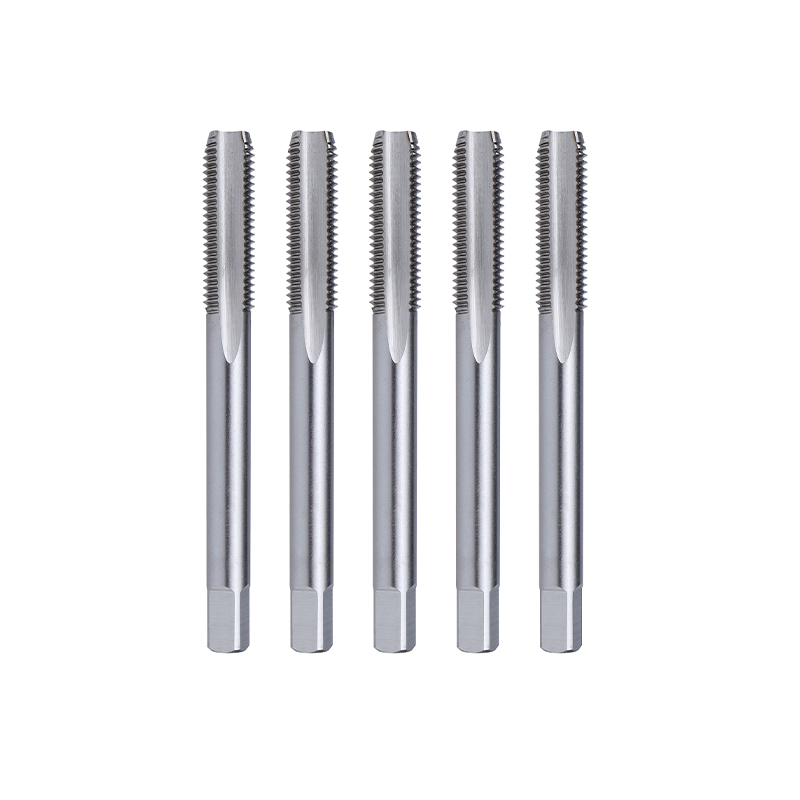 Straight Flute Hand Tap for 2-56 Threading in Soft MetalsThis standard straight flute tap suits shallow 2-56 holes and light-duty work in aluminum and copper. It is mentioned while choosing taps for prototype or production, and its tolerance pairs well with the pin gauge verification step described next.View Product →
Finally, verify the drilled hole before tapping when the part is expensive or difficult to rework. A simple pin gauge that slips smoothly into the hole is often enough to confirm the diameter. The tolerance on the drilled hole is generous for hand tapping, but a worn drill that cuts undersized will turn a routine 2-56 operation into a constant fight with broken taps.
Common 2-56 Tapping Mistakes and How to Avoid Them
Most scrambled or broken 2-56 threads come from a repeatable set of mistakes, not from bad material. We have compiled the list below from real production experience, including both our own shop floor and customer returns that came back for root-cause analysis.
- Using a #51 drill in steel without increasing lubrication. The higher engagement raises torque, and a hand tap will seize if the flutes clog.
- Drilling with a dull bit that cuts oversize. An oversized pilot hole is the leading cause of thread strip-out in thin panels because the effective engagement drops below 50 percent.
- Starting the tap crooked. A 2-56 tap has very little shank length to help with alignment, and any tilt causes a bell-mouth profile that will not pass a plug gauge.
- Running the tap too deep in a blind hole. The spiral chips compact at the bottom, and the tap either jams or breaks. Use a spiral flute tap for blind holes.
- Skipping the chamfer. The burr produced by the drill wraps around the tap tip and is drawn into the hole, where it creates high friction and poor thread quality.
- Using the wrong tap type for the hole. A bottoming tap used from the start has no lead-in and cannot self-align, so it will cut oversized at the mouth.
- Overtightening the tap wrench. When the tap stops cutting, many beginners apply more force instead of reversing to clear chips.
If a tap does break in a 2-56 hole, do not panic. A carbide end mill can grind out the broken tap if the hole is accessible, or you can use a thread insert extraction tool to remove a damaged insert. For a broken tap, electrical discharge machining is the definitive solution for high-value parts, but for most aluminum and steel parts you can carefully drill out the tap with a carbide drill and then convert the oversized hole to a thread repair insert hole. We cover this process in the next section.
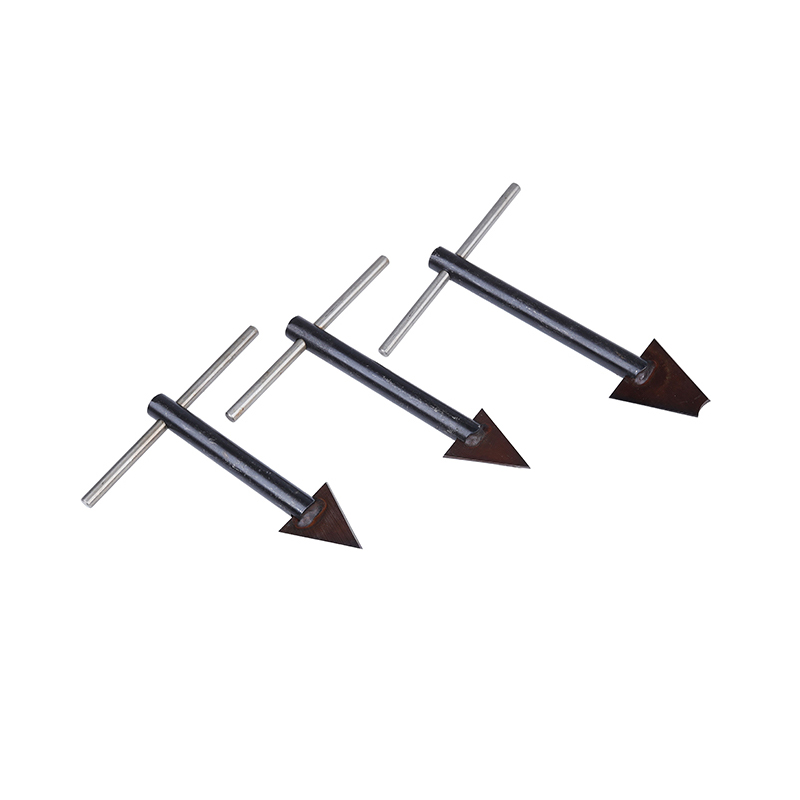 Thread Insert Removal Tool for Damaged CoilsThis tool extracts stuck or broken thread inserts without harming the base threads. It is relevant here because the text explains how to convert an oversized 2-56 hole and remove a failed insert, making this tool a practical addition to repair kits.View Product →
Repairing Stripped or Oversized 2-56 Threads
When a 2-56 tapped strip is stripped or the original hole is oversized, the cheapest solution is usually to install a wire thread insert. Wire thread inserts, also called helical coil inserts or thread repair inserts, replace the damaged internal thread with a new stainless steel coil that accepts the original 2-56 screw. The repair process requires a specific drill bit, but it is a different diameter from the original tap drill because the insert must have enough grip to resist rotation and the external thread of the insert must seat in the parent material.
For a 2-56 thread repair, the procedure is as follows. First, drill out the damaged thread with the insert kit's marked drill, which is typically a #43 bit at 0.0890 inch when the insert is key-locking type, or the size stamped on the kit for a wire insert. Second, tap the hole with the special tap supplied in the kit; the tap creates the larger internal thread that matches the external diameter of the insert. Third, wind the insert onto the installation tool and drive it into the hole until it sits slightly below the surface. Finally, break off the tang if you are using a standard wire insert, or simply verify the bore with a 2-56 screw. A tangless insert skips the tang-breaking step, which is a real advantage in a confined space.
Wire thread inserts are particularly useful for 2-56 holes in aluminum, magnesium, or zinc die castings, where the original thread is easy to strip and where replacing the entire housing would be uneconomic. They are also used intentionally at the design stage: the screw engages the hard stainless steel coil, while the coil transfers the load through a larger surface area into the soft parent metal. This is why many automotive engine and transmission components specify inserts as standard practice in aluminum housings. For details on the installation sequence, see our step-by-step article on how to install metal threaded inserts.
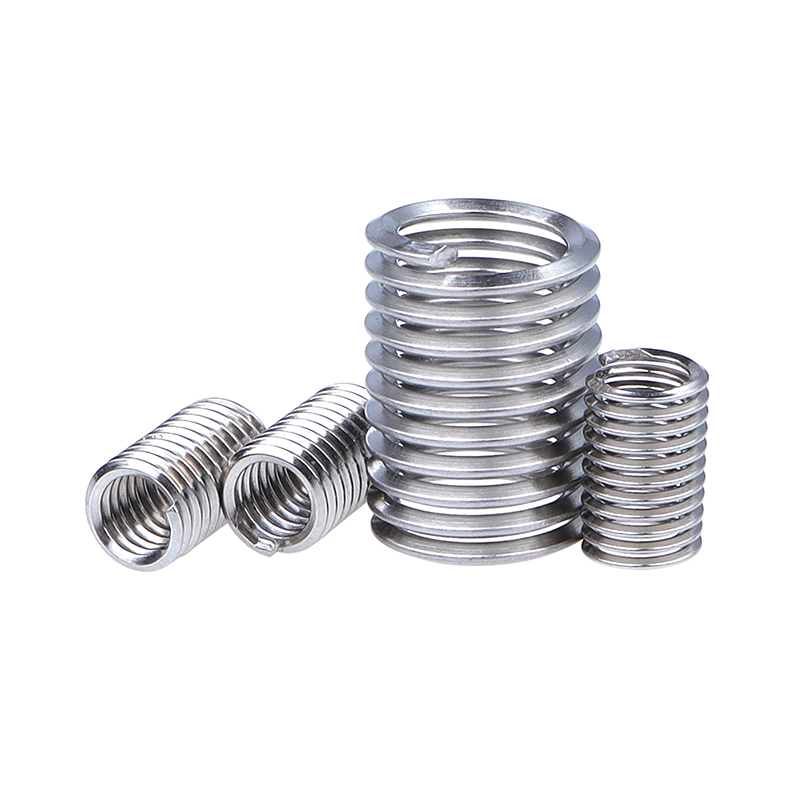 Tangless Wire Thread Insert for Design-Stage RepairsThis tangless insert eliminates the removal step and installs from either end, speeding production. The surrounding text highlights using inserts in aluminum housings to prevent stripped threads, and this version suits high-volume assembly and service environments.View Product →
If you manufacture products that see repeated servicing, such as valve covers, sensor housings, or motor end caps, specifying a wire thread insert in the design from the beginning can eliminate the most common field failure. The insert adds a small initial cost but removes the risk of scrapping a complete housing because one small thread is damaged. Qualified buyers in aerospace and defense programs especially value this approach, because the insert is a documented, traceable standard part that does not change the external envelope of the component.
Related Thread Sizes and Selection Guidance
The 2-56 thread sits in a family of small inch threads where the correct drill size changes quickly as the screw size increases. It is helpful to place 2-56 in context with its nearest neighbors when you are setting up a machine for a batch of mixed small fasteners.
| Thread | Series | Major diameter (in) | TPI | Tap drill | Drill diameter (in) | Primary material |
|---|---|---|---|---|---|---|
| 1-64 | UNC | 0.0730 | 64 | #53 | 0.0595 | Instrumentation |
| 2-56 | UNC | 0.0860 | 56 | #50 | 0.0700 | General purpose |
| 2-64 | UNF | 0.0860 | 64 | #50 | 0.0700 | Fine adjustment |
| 3-48 | UNC | 0.0990 | 48 | #47 | 0.0785 | Electronics hardware |
| 4-40 | UNC | 0.1120 | 40 | #43 | 0.0890 | Enclosures, brackets |
| M2 x 0.40 | Metric | 0.0787 | 63.5 | 1.60 mm | 0.0630 | Global products |
Notice that the 2-64 fine thread shares the same tap drill as 2-56, which is convenient but also a trap. The finer pitch of 2-64 has a smaller thread height, so the same drilled hole produces slightly more engagement. In practice, a #50 is correct for both, and you do not need to change drills when switching between 2-56 and 2-64 on the same part.
When you compare 2-56 with M2, the metric thread is slightly smaller in major diameter at 0.0787 inch versus 0.0860 inch. The closest metric tap drill for M2 x 0.40 is 1.60 mm at 0.0630 inch. If a drawing shows an M2 tapped hole, do not substitute a 2-56 tap and #50 drill; the sizes are close enough to confuse but far enough apart to fail a gauge. This is one of the most common mix-ups in mixed-unit shops, and it leads directly to rework and customer complaints.
For high-volume production, the best way to avoid confusion is to standardize on either inch or metric hardware for a product line. A contract manufacturer that supports both systems needs clear color coding on tool holders and a strict protocol for drill sets. Forklift maintenance and rail vehicle maintenance shops, which often work with both legacy inch hardware and newer metric components, should keep separate tap and drill kits for the two systems.
Manufacturer's Perspective: Sourcing Taps and Threaded Inserts for Production
Buying taps, drills, and thread repair inserts is different from buying them for a home shop. When you are sourcing high volumes of threading tooling for a production line, the metrics that matter are batch-to-batch consistency, coating quality, and the supplier's ability to maintain a stable supply at a negotiated wholesale price. A reputable thread manufacturer such as Dongtai Jinzhize Metal Products Co., Ltd. runs automated production lines that generate thousands of thread inserts, taps, and installation tools per day, which gives purchasing managers a single accountable partner for the whole fastening system.
For OEMs that assemble electronics, automotive sensors, or aerospace sub-assemblies, the relationship between the drilled hole and the threading tool cannot be an afterthought. If your CNC programmer sets the 2-56 tap drill size at #50 but the tap supplier changes the geometry of the insert or the chamfer length, the tapping torque can shift by 20 percent or more. Working directly with a manufacturer who produces both the cutting tool and the threaded insert eliminates that risk because the two products are designed and gauged together. Many international customers in Brazil, Europe, and Southeast Asia have adopted this approach when they buy from us as a supplier of complete threading solutions.
Wholesale buyers should also ask about surface treatment and packaging standards. For self-tapping thread inserts and wire thread inserts, plating quality affects installation torque and corrosion resistance. A manufacturer that can produce both a yellow zinc plated carbon steel insert and a 303/304/316 stainless steel insert from stock will shorten your lead time significantly. When your quality system requires material certificates and lot traceability, verify that the manufacturer can provide them for every box of taps and inserts that leaves the warehouse.
Finally, consider the total lifecycle cost, not just the unit price. A slightly more expensive tap with a better coating will often thread three times as many 2-56 holes before it needs resharpening. The same logic applies to thread inserts: the cost of an insert is small compared with the cost of a scrapped cylinder head or transmission housing. Purchasing managers who understand this trade-off typically favor an established manufacturer with a documented quality management system over the lowest bidder.
Frequently Asked Questions About the 2-56 Tap Drill Size
These are the questions that machine operators, design engineers, and purchasing agents most often ask when they prepare to tap a 2-56 hole.
What size drill bit do I use for a 2-56 tap?The standard answer is a #50 drill bit, which is 0.0700 inch in diameter. This drill size gives a balanced thread that is strong enough for most jobs while keeping the tapping torque low enough for a small hand or machine tap. |
Can I use a #51 drill instead of a #50 for a 2-56 tap?Yes. A #51 drill at 0.0670 inch produces a higher thread engagement, roughly 82 percent, which makes the thread stronger but also increases tapping resistance. Use #51 only when the material is soft, the hole is short, or you need maximum pull-out strength. |
What is the closest metric drill bit to a #50 for 2-56 tapping?The closest metric sizes are 1.80 mm at 0.0709 inch and 1.75 mm at 0.0689 inch. The 1.80 mm drill behaves almost identically to #50, while the 1.75 mm drill lands closer to the theoretical 75 percent engagement point. |
Does the 2-56 tap drill size change for aluminum versus steel?For most work, no. A #50 drill works well in both aluminum and steel. If you are tapping deep blind holes in 300-series stainless steel, you may prefer a #51 to gain more thread, provided you use a quality spiral flute tap and heavy cutting fluid. |
Should I use a cutting tap or a forming tap for a 2-56 hole?A cutting tap is the safest choice for general work, especially in steel and stainless. A forming tap works well in aluminum and brass but requires a larger pilot hole, usually around a #48 or #49 drill at 0.0760 to 0.0730 inch, because it displaces material instead of removing chips. |
How deep should I drill before tapping a 2-56 blind hole?Drill at least one full thread diameter deeper than the required thread length. For a 2-56 thread with a nominal diameter of 0.086 inch, that means the drilled pilot hole should extend at least 0.086 inch beyond the deepest thread you need, and ideally more, so the tap has room for chips. |
Related Reading and Trusted References
If you are setting up a new production line or simply expanding your knowledge of threading operations, the following resources from our engineering library will help you make better decisions. They cover tap selection, installation methods, and the broader family of threaded connection products.
|
How to Choose a Thread Tap Compare flute styles, coatings, and tap geometries so you can select the right tool for 2-56 holes in any material. This guide walks through the selection factors that affect thread quality and tool life. |
How to Install Metal Threaded Inserts A step-by-step walkthrough of wire thread insert installation, including drill size, tapping, and insertion depth. This is the practical companion for any 2-56 thread repair job. |
Both guides are written by our engineers with production floor experience in automotive, aerospace, and rail applications. You can also explore our product pages for thread inserts, installation tools, and taps to see the exact components available for large-scale supply agreements.



