

 Français
 Español
 Deutsch

Content
- 1 303 Stainless Steel Material Properties at a Glance
- 2 Chemical Composition and Grade Designations
- 3 Mechanical Properties of 303 Stainless Steel
- 4 Physical and Thermal Properties of 303 Stainless Steel
- 5 Machinability: The Property That Sells 303
- 6 Corrosion Resistance of 303 Stainless Steel
- 7 Heat Resistance, Heat Treatment and Welding Behaviour
- 8 303 vs 304 vs 316: Choosing on Properties, Not Habit
- 9 Applications: Where 303 Properties Pay Off in Threaded Components
- 10 Maintenance and In-Service Practice
- 11 Sourcing 303 Stainless Steel Components: What to Specify
- 12 Frequently Asked Questions
- 12.1 What are the most important 303 stainless steel material properties?
- 12.2 Is 303 stainless steel magnetic?
- 12.3 Can 303 stainless steel be hardened by heat treatment?
- 12.4 Why is 303 easier to machine than 304?
- 12.5 Can 303 stainless steel be welded?
- 12.6 Is 303 suitable for marine or coastal environments?
- 12.7 What is the difference between 303 and 303Se?
- 12.8 How much thread engagement does a 303 insert need?
- 12.9 How should a buyer verify incoming 303 components?
- 12.10 Does 303 stainless steel cost more than 304?
- 13 Related Pages on This Site
A drawing lands on a machinist's bench. The callout says "303 stainless" for a small threaded oil drain plug and a batch of self-tapping inserts. Nobody asks whether the part will be strong enough, because strength was never the reason the grade was picked. The part was picked because a screw machine has to turn thousands of them per shift with chips that break cleanly, and because the finished component still has to survive years of moisture, road salt spray and workshop humidity. That trade-off is precisely what 303 stainless steel material properties describe: an austenitic grade engineered for machining first and corrosion resistance second.
The short version, before the detail: 303 (UNS S30300, EN 1.4305, X8CrNiS18-9) is an 18/8-type chromium-nickel austenitic stainless steel with 0.15 to 0.35 percent sulfur added deliberately to break chips. It cannot be hardened by heat treatment, it is essentially non-magnetic in the annealed condition, its annealed tensile strength sits in the 500 to 700 MPa band, and its general corrosion resistance tracks close to 304. The one place it clearly falls behind is chloride pitting resistance, because the same manganese sulfide inclusions that make it machine so beautifully are also the first thing to dissolve in an aggressive environment.
This article walks through the composition, mechanical and physical data, machinability, corrosion behaviour, heat and welding limits, selection logic and sourcing checks that sit behind that short answer. It is written for engineers, buyers and quality staff who have to justify a material choice on a drawing or a purchase order, not for a textbook.
Key takeaway: 303 stainless steel is a free-machining austenitic grade that trades chloride pitting resistance for one of the highest machining speeds of any stainless steel, which is why it dominates screw-machined parts such as thread inserts, adapters and drain plugs.
303 Stainless Steel Material Properties at a Glance
Before drilling into individual values, it helps to see the whole grade in one view. The table below summarises the headline 303 stainless steel material properties that appear on most material certificates and datasheets, together with the practical consequence of each one on the shop floor.
| Property | Typical value | What it means for a threaded component |
|---|---|---|
| Grade family | Austenitic, chromium-nickel | Non-hardenable by heat treatment; strength comes from cold work |
| UNS / EN designation | S30300 / 1.4305 | Interchangeable on most drawings with AISI 303 and X8CrNiS18-9 |
| Tensile strength (annealed) | 500 to 700 MPa | Adequate for inserts and plugs loaded in shear and compression |
| 0.2 percent yield strength (annealed) | 190 to 260 MPa | Low yield drives the need for generous thread engagement |
| Elongation | 35 to 50 percent | Good ductility, so threads roll and deform rather than crack |
| Hardness (annealed) | 160 to 200 HB | Machinable with standard carbide tooling at high surface speed |
| Relative machinability | About 78 percent of B1112 | Roughly 1.7 times faster to cut than 304 |
| Magnetic behaviour | Essentially non-magnetic when annealed | Slight magnetism after cold working or thread rolling |
| Chloride pitting resistance | Lower than 304 and much lower than 316 | Avoid marine, chemical and heavy de-icing exposure |
Key takeaway: if a specification only says "stainless", 303 and 304 are not interchangeable in a chloride environment, even though they look identical on the shelf.
Chemical Composition and Grade Designations
Alloy 303 is the free-machining modification of the 18/8 austenitic family. Its base chemistry is essentially 304 with controlled additions of sulfur or selenium, and a slightly relaxed carbon and phosphorus limit that reflects the realities of high-volume bar production rather than any attempt to improve corrosion performance.
| Element | Range | Role in the grade |
|---|---|---|
| Carbon (C) | 0.15 max | Capped to limit chromium carbide formation along grain boundaries |
| Silicon (Si) | 1.00 max | Deoxidation during melting; residual levels affect machinability slightly |
| Manganese (Mn) | 2.00 max | Combines with sulfur to form the manganese sulfide inclusions that break chips |
| Phosphorus (P) | 0.20 max | Higher than 304 allowance; contributes slightly to chip brittleness |
| Sulfur (S) | 0.15 to 0.35 | The defining addition; creates internal notches that shorten chips |
| Chromium (Cr) | 17.0 to 19.0 | Forms the passive oxide film that provides corrosion resistance |
| Nickel (Ni) | 8.0 to 10.0 | Stabilises the austenitic structure and provides ductility and toughness |
| Molybdenum (Mo) | 0.60 max (optional) | Not intentionally added; absence is what separates 303 from 316 |
The sulfur content is the single most important number in that table, and it is also the most frequently mis-specified. A heat at 0.15 percent sulfur machines noticeably worse than a heat at 0.30 percent, yet both are fully compliant with the 303 specification. For a screw machine shop producing millions of small inserts per year, that spread translates directly into tool changes, cycle time and scrap rate.
Selenium and copper variants
Two variants appear regularly on drawings and should not be treated as identical to standard 303:
- 303Se (UNS S30323) - selenium replaces sulfur as the free-machining addition. Chip control is good and the surface finish is often better, but the machinability index is a little lower than sulfur-bearing 303. The main reason to select it is improved hot and cold formability, and slightly better corrosion resistance because selenium inclusions are less aggressive pit initiators than sulfides.
- 303Cu - a copper-bearing variant used where improved cold heading or slightly better corrosion performance is needed. It is common in fastener stock and in wire for cold-formed parts.
- 303Sulf and generic 303 - commercial designations that should always be tied back to a written chemistry range and a certificate, because "303" alone does not define sulfur content, hardness temper or delivery condition.
Grade equivalents worth knowing when reviewing import documentation include AISI 303, UNS S30300, EN 1.4305, Werkstoff 1.4305, X8CrNiS18-9, JIS SUS303 and GB/T Y1Cr18Ni9. In practice, a supplier in Asia, Europe or North America will all quote the same family, but the certificate format and the test scope differ, so the purchase order needs to state which standard governs.
Key takeaway: sulfur between 0.15 and 0.35 percent is what makes 303 machine well, but the exact point inside that window is a purchasing variable that should be pinned down for high-volume work.
Mechanical Properties of 303 Stainless Steel
Mechanical data for 303 is always condition-dependent, and this is where most specification errors happen. A datasheet quoted for annealed bar looks weak next to one quoted for cold-drawn bar of the same grade, and both are correct. The reason is that 303 is austenitic and cannot be strengthened by quenching or tempering. The only lever available is cold work, applied either as bar drawing before machining or as thread rolling and forming after it.
| Property | Annealed bar | Cold-drawn or rolled bar |
|---|---|---|
| Tensile strength | 500 to 700 MPa | 690 to 860 MPa |
| 0.2 percent yield strength | 190 to 260 MPa | 450 to 700 MPa |
| Elongation in 50 mm | 35 to 50 percent | 10 to 25 percent |
| Reduction of area | About 50 percent | About 35 percent |
| Hardness | 160 to 200 HB | 230 to 320 HB |
| Modulus of elasticity | 193 to 200 GPa | 193 to 200 GPa |
| Poisson's ratio | 0.30 | 0.30 |
Two consequences follow from that table. First, the yield-to-tensile ratio of annealed 303 is low, roughly 0.35 to 0.45, which means the material deforms noticeably before it fractures. For a thread insert or a conversion nut, that ductility is helpful: thread flanks can conform to a slightly imperfect mating thread rather than cracking. Second, the same ductility means a thread can be pulled out of a soft parent material long before the insert itself fails, so the parent material strength and the engaged thread length usually govern the joint.
Strength versus engagement, not strength alone
A common mistake in aluminium housings is to specify a stronger insert rather than more engagement. If a 303 stainless insert is installed in a die-cast aluminium boss with only four engaged threads, the aluminium shears first regardless of the insert grade. Practical engagement rules that hold up in production are:
- For steel and cast iron parents, aim for at least 1.0 to 1.5 times the nominal diameter of engaged thread.
- For aluminium and magnesium parents, aim for 2.0 times the nominal diameter or use a key-locking or three-hole insert designed to spread load.
- For plastics and composites, load is carried by a bonded or moulded insert rather than by thread engagement, and 303's role is limited to the internal thread form.
- Where vibration is present, specify a screw-locking wire insert or a locking patch rather than relying on torque alone.
Fatigue performance follows the same logic. The endurance limit of annealed 303 in rotating bending sits well below that of cold-worked bar, and in a threaded joint the fatigue life is dominated by the notch at the first engaged thread. Rolling the thread after machining leaves compressive residual stress at the root and improves fatigue life substantially compared with cutting, which is one reason thread rolling remains the default for high-volume stainless fasteners.
Key takeaway: 303 cannot be heat treated, so any strength requirement above roughly 700 MPa must be met by specifying a cold-worked temper and accepting lower ductility.
Physical and Thermal Properties of 303 Stainless Steel
Physical data matters more than most designers expect, particularly in assemblies that see temperature cycling. A stainless insert in an aluminium housing expands at a different rate from the parent metal, and the resulting change in preload is often what loosens a joint, not vibration alone.
| Property | Typical value | Design implication |
|---|---|---|
| Density | 7.9 g/cm3 | Component mass is close to carbon steel for the same geometry |
| Melting range | 1400 to 1420 °C | Far above any automotive or aerospace service temperature |
| Specific heat | About 500 J/kg·K | Slow to heat and slow to cool compared with aluminium |
| Thermal conductivity at 100 °C | About 16.2 W/m·K | Poor heat removal, so keep cutting fluid flowing during machining |
| Electrical resistivity | About 0.72 micro-ohm metre | Not a material of choice for conductive paths |
| Thermal expansion, 20 to 100 °C | About 17.3 x 10⁻⁶ per K | Lower than aluminium at roughly 23, which changes preload when hot |
| Relative magnetic permeability | About 1.02 annealed, up to about 3 when cold worked | Verify magnetism requirements against the actual temper |
| Modulus of elasticity | 193 to 200 GPa | Stiffer than aluminium, so load sharing favours the insert |
The magnetic behaviour deserves a specific note. Many customers reject a stainless part because a magnet sticks to it. In 303, a weak attraction is normal and expected after cold drawing, thread rolling or severe machining, because those operations partially transform the austenite to martensite. A fully annealed, stress-relieved 303 part will show permeability close to 1.02, while a heavily cold-formed part can show several times that figure. If a specification demands non-magnetic behaviour, the requirement must be written against the finished condition, not the raw material.
The thermal expansion figure also explains a practical field problem. When a stainless plug is installed in an aluminium housing and the assembly heats up, aluminium grows faster. If the plug was torqued to a value that assumed a steel housing, preload can drop and the joint can seep. In high-temperature applications, a slightly higher initial torque, a sealing washer with controlled compression, or a thread sealant rated for the temperature range usually solves the problem more reliably than switching grades.
Key takeaway: slight magnetism in a finished 303 part is normal and does not indicate the wrong grade; check permeability requirements against the cold-work condition instead.
Machinability: The Property That Sells 303
Machinability is normally quoted as an index, where free-cutting carbon steel B1112 is set at 100 percent. The index is not a laboratory constant; it is an industry convention that reflects achievable cutting speed for a reasonable tool life. It still answers the question every production planner asks, which is how many parts per hour a given grade will yield before tool wear forces a change. Three things drive the index for a stainless grade: the chemistry of the inclusions, the work-hardening rate of the austenitic matrix, and the thermal conductivity, which determines how much heat the tool has to absorb. The manganese sulfide inclusions in 303 act as internal stress risers, so the chip fractures into short segments instead of forming a long, tangled bird's nest around the tool. That single behaviour allows higher surface speeds, heavier feeds and less operator intervention. The chart below places 303 alongside other common grades using the same index.
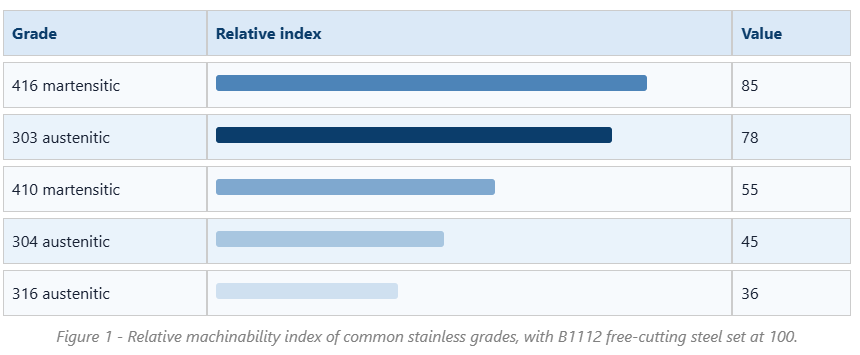
The gap between 303 and 304 is the single most commercially significant fact in this article. At an index of 78 against 45, 303 removes material faster, generates shorter chips and produces far fewer tool changes per shift. On a multi-spindle screw machine running small parts, that difference often decides whether a job is profitable. It also explains why almost every small stainless threaded component on the market, from wire insert blanks to drain plugs, is quoted in 303 by default unless the customer asks for something else.
The advantage is not unlimited, and it comes with real penalties. The sulfide inclusions reduce corrosion resistance, as discussed later, and they also make the material less suitable for welding because sulfur promotes hot cracking. Surface finish can be excellent, but if a passivating acid treatment follows machining, the inclusions can leave microscopic pits that look like defects under magnification. Tool wear is better than 304 but still far from carbon steel, so carbide grades with a tough substrate and a PVD coating are the usual choice. Coolant pressure matters because 303 conducts heat poorly; high-pressure through-tool coolant keeps the cutting edge below the temperature where built-up edge starts to form.
Typical starting parameters for turning annealed 303 with coated carbide are a surface speed around 150 to 200 metres per minute and a feed of 0.10 to 0.25 millimetres per revolution, with the exact figures adjusted for depth of cut and rigidity. High-speed steel tooling is still used for small-diameter tapping and for form tools, but at much lower speeds, usually 25 to 40 metres per minute. Tapping is the operation where 303 earns its reputation, because the short chips clear flutes far more readily than the stringy chips produced by 304, which drastically reduces tap breakage in blind holes.
Another practical point is consistency. Because the sulfur range is wide, two heats of compliant 303 can behave differently. A shop running a high-volume job should ask the mill or the component manufacturer to hold the free-machining addition in the upper half of the range if cycle time and tool life are critical. Where surface finish or formability matters more, a lower sulfur or a selenium-bearing variant is the better trade.
Finally, machinability is not only about speed. It is also about scrap, deburring and inspection cost. Free-cutting grades produce smaller burrs, dimensionally stable parts and more predictable thread gauging, which reduces the number of parts rejected at final inspection. On a part with several threads, a cross-hole and a sealing face, those secondary savings can exceed the savings in cycle time.
It is worth remembering that the index in the chart assumes a specific set of reference conditions, usually single-point turning with carbide tooling and a fixed tool life criterion. Changing the operation changes the ranking slightly. Drilling, for example, is more sensitive to chip evacuation than turning, so the relative advantage of 303 over 304 is even larger in deep-hole drilling and tapping than the index alone suggests.
Key takeaway: 303 exists because of its machinability index of roughly 78, and any decision to switch to 304 or 316 for corrosion reasons should be costed against a cycle time increase of 40 percent or more.
Corrosion Resistance of 303 Stainless Steel
In clean rural and indoor atmospheres, 303 performs close to 304 and will hold a bright surface for years. Fresh water, mild detergents, many food-contact environments that are not chloride-heavy, and most automotive under-hood conditions with occasional moisture are all acceptable. The problems start when chlorides are present in meaningful concentration.
The mechanism is straightforward. Manganese sulfide inclusions interrupt the passive chromium oxide film. In the presence of chloride ions, those inclusions dissolve preferentially, creating micro-crevices where the local chemistry turns acidic and oxygen-starved. Once a pit initiates, it propagates because the pit interior becomes an anode and the surrounding surface acts as a large cathode. This is why a 303 part can look spotless for two years in an inland plant and then show pitting within months when the same part is installed near a coastal site or exposed to de-icing salt.
Pitting resistance is often compared using the pitting resistance equivalent number, calculated from chromium, molybdenum and nitrogen content. For 303 there is no intentional molybdenum or nitrogen, so the value lands in the region of 17 to 19, similar to 304 but with a much higher density of initiation sites. Grade 316 adds molybdenum and reaches roughly 24 to 26, which is why it remains the default for marine and chemical service.
| Factor | 303 | 304 | 316 |
|---|---|---|---|
| Pitting resistance equivalent | About 17 to 19 | About 18 to 19 | About 24 to 26 |
| Pit initiation sites | High, from sulfide inclusions | Low | Very low |
| Relative machinability | About 78 | About 45 | About 36 |
| Marine or coastal exposure | Not recommended | Limited | Recommended |
| Weldability | Poor, hot cracking risk | Good | Good |
| Typical threaded part use | Inserts, adapters, drain plugs | General fasteners and inserts | Marine and process fittings |
There is one mitigation worth knowing. Passivation in citric or nitric acid after machining removes free iron and surface contamination, and it does slightly improve the performance of 303 by cleaning out the outermost inclusions. It does not change the bulk chemistry and it will not rescue a part used in a chloride-rich environment. Electropolishing goes a step further by removing a thin surface layer entirely, which improves the appearance and the initiation resistance, but again the benefit is limited to the skin.
For drain plugs and other sealing components, the environment is usually less aggressive than it looks. Engine oil, transmission fluid and coolant are not typically chloride-bearing, and the plug sees a sump interior rather than a splash zone. That is why 303/304/316 stainless oil plugs are commonly offered as a family, letting the buyer match grade to exposure rather than defaulting to the most expensive option.
The sensible selection rule is to use 303 where the part is machined in high volume and the environment is benign, switch to 304 where some chloride exposure and moderate corrosion are possible, and move to 316 where the part will see salt, sea air or process chemicals. Going the other way, choosing 316 for an indoor dry application, adds cost without measurable benefit.
Key takeaway: 303 is a fine choice for indoor, oily and mildly humid service, but it should never be specified for coastal, marine or chloride-rich environments where pitting initiates at the sulfide inclusions.
Heat Resistance, Heat Treatment and Welding Behaviour
Datasheets commonly state that 303 resists oxidation when intermittently exposed up to about 760 °C and in continuous service up to roughly 870 °C. Those figures describe oxide scale formation, not structural suitability. The sulfur addition that makes the grade machinable is also the reason it is not a good choice for elevated-temperature service, because sulfides can promote embrittlement and accelerated attack at grain boundaries.
Heat treatment facts that matter
- 303 cannot be hardened by heat treatment. Any hardness requirement must be met through cold working, not through quenching or ageing.
- Annealing is performed in the range of roughly 1010 to 1120 °C followed by rapid cooling, and its purpose is to soften cold-worked material and restore ductility, not to increase strength.
- Stress relief of machined parts is typically carried out at around 350 to 400 °C. This range is chosen deliberately to stay below the sensitisation window where chromium carbides form at grain boundaries.
- Prolonged exposure between roughly 425 and 815 °C should be avoided, because chromium carbide precipitation removes chromium from the surrounding matrix and leaves a corrosion-prone band.
Welding is the weak point
303 is generally regarded as unsuitable for welding. Sulfur lowers the solidification temperature range and promotes hot cracking in the weld bead, and it also increases porosity. If a design requires welding, the usual approach is to switch the component to 304 or 316, or to a low-sulfur filler and base combination. Where a 303 part genuinely must be joined, welding should be limited to low-heat-input processes with 308L filler, followed by full annealing and pickling, but even then the corrosion resistance of the weld and heat-affected zone will be inferior to the parent metal.
Cold forming and galling
Cold working of 303 is possible but limited. The work-hardening rate is high, similar to other austenitic grades, so severe forming operations such as deep drawing or heavy cold heading are normally done in 303Se or in 304 rather than in sulfur-bearing 303. Thread rolling, in contrast, is well suited to 303 and is the standard way to produce high-strength threads on inserts and small fasteners.
Galling is another austenitic characteristic worth planning for. When two stainless surfaces of similar hardness rub under pressure, they can cold-weld locally and tear, which is why stainless nuts sometimes seize on stainless bolts. In threaded assemblies this is controlled by using dissimilar grades, applying a molybdenum-based anti-seize compound, controlling torque, or specifying a locking insert design that does not rely on repeated disassembly.
Key takeaway: treat 303 as a machined-only material; if the joint must be welded or sees sustained temperatures above about 400 °C, specify 304 or 316 instead.
303 vs 304 vs 316: Choosing on Properties, Not Habit
Grade selection is a balancing exercise between three variables that pull in different directions: machining cost, corrosion demand and strength or ductility requirement. The two-column comparison below sets out the selection logic for the two component families most often affected by a 303 decision.
Threaded inserts and adapters
|
Plugs, fittings and sealing components
|
One frequent misconception is that moving up to 316 is always the safer choice. In practice, a 316 component that galls during assembly and is re-torqued several times can end up less reliable than a correctly torqued 303 part with a proper seal. Material grade is one variable in a system that also includes thread form, tolerance class, surface finish, lubrication and assembly torque.
The cost dimension is real and worth quantifying. Because 316 machines at roughly 36 on the index compared with 78 for 303, the machining time for the same part can be more than double, and the material itself is more expensive. For a high-volume small part, that can mean the unit cost triples. Where the service environment genuinely demands 316, that is money well spent; where it does not, it is simply margin lost.
Key takeaway: select the grade from the actual exposure and the actual machining volume, and write both the grade and the temper on the drawing so the choice is repeatable.
Applications: Where 303 Properties Pay Off in Threaded Components
The properties described above map neatly onto a specific class of component: small, threaded, produced in high volume, and expected to resist rust without being exposed to chlorides. Four product families dominate that space.
Self-tapping thread inserts
A self-tapping insert cuts its own thread into a drilled or cored hole in aluminium, magnesium or plastics. The cutting slots demand clean chip evacuation during installation, and the external thread must be tough enough to cut without chipping. 303 in the annealed or lightly cold-worked condition balances those needs well, and when a stronger or more corrosion-resistant option is required, the same geometry is available in 304 or 316.
Installation quality depends as much on the hole as on the insert. A hole drilled slightly oversize will let the insert spin, while an undersize hole will raise installation torque and can shear the driving keys. Tolerance bands for the pilot hole are normally supplied by the insert manufacturer and should be treated as mandatory rather than advisory.
Three-hole threaded inserts
Three-hole inserts are installed with a dedicated tool that engages three keys, then locked in place. They resist rotation far better than a plain helical insert and are a common choice where vibration or repeated disassembly is expected. The material choice is usually 303 for cost and machinability, with 304 or 316 available where corrosion demand is higher.
Because the loaded thread is internal and protected by the parent material, the corrosion environment seen by the insert is largely the environment inside the assembly, which is often benign. That is one reason 303 performs perfectly well in engines, gearboxes and machine frames even though the same grade would fail quickly on an exposed marine deck fitting.
Key-locking inserts and conversion nuts
Key-locking inserts use external keys driven down through the parent material to lock the insert mechanically. Conversion nuts, also called male-to-female thread adapters, allow a component to switch between metric and inch threads or between different thread pitches. Both benefit from 303's ability to hold tight tolerances on thread form after high-speed machining, and both are typically supplied in carbon steel, 303, 304 or 316 so the buyer can match grade to application.
Oil plugs and thread plugs
Drain plugs and sealing plugs are classic screw-machine parts: simple geometry, tight thread tolerance, high annual volume. The internal environment is normally oil or coolant, while the external environment might be an engine bay, a machine base or an outdoor enclosure. Choosing 303 for indoor equipment and 316 for exposed marine equipment is the standard, cost-effective split.
A final application note concerns dissimilar metal contact. When a stainless insert is installed in an aluminium housing, the joint forms a galvanic couple, and in the presence of an electrolyte the aluminium becomes the anode. This is rarely a problem in dry indoor equipment, but in wet or salt-laden environments it accelerates corrosion of the parent metal around the insert. Protective coatings, sealants or a change of parent material are the usual corrective actions.
Key takeaway: the internal thread of an insert usually sees a mild environment, so 303 remains the standard choice for high-volume inserts unless the assembly itself is exposed to chlorides.
Maintenance and In-Service Practice
Material selection gets a component to the start line; maintenance practice determines how it performs over a service life. Stainless threaded components fail for a small number of predictable reasons, and most of them are preventable.
- Over-torque. Because annealed 303 has a yield strength around 190 to 260 MPa, a torque value copied from a steel fastener table can stretch or strip threads. Always use torque data published for the specific insert or plug, and recalibrate drivers regularly.
- Galling. Stainless on stainless contact under pressure can seize. Anti-seize compound, a dissimilar mating grade, or a lubricated installation procedure removes most of the risk.
- Insufficient engagement. A plug that is two threads short of full engagement will leak regardless of grade. Verify engagement depth during first-article inspection, not after field failure.
- Chloride attack. Pitting on a 303 part is a sign that the grade is wrong for the environment, not that the part is defective. Replace with 316 or add a protective barrier.
- Galvanic corrosion of the parent. Look for white or grey corrosion product around a stainless insert in an aluminium housing, which indicates the aluminium is being consumed.
Inspection practice should match the failure mode. Visual inspection catches pitting, corrosion staining and thread damage. Thread gauging catches dimensional drift after installation. For critical joints, a torque check after the first thermal cycle is more informative than a torque check at assembly, because it reveals whether preload was lost. Periodic chemical verification using a handheld X-ray fluorescence analyser will confirm that incoming material is genuinely 303 and not a substituted grade, which is a common problem in mixed inventory.
Storage also matters more than it appears. Stainless components stored in open wooden bins in a humid warehouse can pick up surface contamination and develop rust spots that are cosmetic rather than structural, but they will still trigger a customer complaint. Keeping parts in sealed packaging with a volatile corrosion inhibitor, and handling them with clean gloves, avoids most of these disputes.
Key takeaway: most 303 component failures in the field trace back to torque, engagement or environment, not to the material itself, so maintenance procedures deserve the same attention as the grade callout.
Sourcing 303 Stainless Steel Components: What to Specify
Because 303 has a wide permissible chemistry range and several tempers, the purchase order carries most of the quality risk. A capable manufacturer or supplier should be able to answer every one of the following points without hesitation.
| Item to specify | Why it matters |
|---|---|
| Grade and standard | UNS S30300 or EN 1.4305, stated explicitly rather than "stainless" |
| Sulfur range | Determines machining consistency and, indirectly, pitting behaviour |
| Delivery condition | Annealed or cold drawn; affects strength and ductility by a wide margin |
| Hardness range | An easy verification point for incoming inspection |
| Material certificate | EN 10204 3.1 with heat number traceability to the finished batch |
| Thread tolerance class | 6H, 6g or customer-specific; verified with go and no-go gauges |
| Surface treatment | Passivation, plating or dry film lubrication, with a defined test |
| Sampling plan | Defines how many parts per lot are inspected and against which criteria |
| Packaging | Prevents contamination, moisture damage and transit damage |
Working with a manufacturer that also controls the installation tooling removes a class of problems. When the insert and the driving tool are designed together, installation torque, key engagement and hole tolerance are consistent, and field complaints about stripped holes drop sharply. This matters particularly for self-tapping and three-hole inserts, where the driving feature is as critical as the thread itself.
Volume buyers should also ask about lot-to-lot repeatability, not just first-article approval. A consistent heat of 303 from a stable mill source, with a controlled sulfur content, allows a shop to lock in cutting parameters and hold them for years. When the mill source changes, machining behaviour can shift even though the certificate looks identical, and the first sign is usually increased tool wear or a rise in thread gauge rejections.
Finally, verify capability rather than promises. Ask for the actual production equipment, the inspection process and the traceability chain from raw bar to packed carton. A supplier who can show a documented route from heat number to finished part is far easier to manage than one who can only show a certificate folder.
Key takeaway: specify grade, sulfur range, temper and certificate type on the purchase order; without those four items, two suppliers can both claim to deliver "303" and still deliver parts that behave differently.
Frequently Asked Questions
What are the most important 303 stainless steel material properties?The defining properties are a sulfur content of 0.15 to 0.35 percent for chip breaking, a machinability index of roughly 78 against B1112, annealed tensile strength of 500 to 700 MPa, a 0.2 percent yield strength of 190 to 260 MPa, elongation of 35 to 50 percent, hardness of 160 to 200 HB, and essentially non-magnetic behaviour in the annealed condition. Corrosion resistance is comparable to 304 except for noticeably lower chloride pitting resistance. |
Is 303 stainless steel magnetic?Annealed 303 is essentially non-magnetic, with a relative permeability near 1.02. Cold drawing, thread rolling and heavy machining partially transform the austenite to martensite, so a finished part can become weakly magnetic with permeability of up to about 3. A magnet sticking slightly to a machined 303 component is normal and does not mean the wrong grade was supplied. |
Can 303 stainless steel be hardened by heat treatment?No. It is an austenitic grade and does not respond to quenching or tempering. The only way to raise strength is cold working, which can push tensile strength to roughly 690 to 860 MPa at the cost of ductility. Annealing is used only to soften cold-worked material and restore ductility. |
Why is 303 easier to machine than 304?The sulfur addition forms manganese sulfide inclusions throughout the matrix. These inclusions act as internal notches that cause the chip to fracture into short segments instead of forming a long string. Short chips clear the cutting zone, reduce built-up edge, lower cutting forces and allow higher surface speeds, which is why 303 machines at roughly 1.7 times the speed of 304. |
Can 303 stainless steel be welded?It is generally not recommended. Sulfur promotes hot cracking and porosity in the weld bead, and the heat-affected zone loses corrosion resistance. Where welding is unavoidable, use a low-heat-input process with 308L filler and plan for full annealing and pickling, or switch the component to 304 or 316. |
Is 303 suitable for marine or coastal environments?No. Chloride exposure causes pitting that initiates at the sulfide inclusions. Even though the general corrosion performance is close to 304, the density of pit initiation sites is much higher, so 303 should be reserved for indoor, oily or mildly humid service. Grade 316 is the appropriate choice for marine and chemical environments. |
What is the difference between 303 and 303Se?Both are free-machining grades, but 303Se uses selenium instead of sulfur. Selenium provides similar chip control with better surface finish and improved hot and cold formability, and its inclusions are slightly less aggressive pit initiators. Sulfur-bearing 303 generally offers the higher machinability index and lower cost, so it remains the default for screw-machined parts. |
How much thread engagement does a 303 insert need?A practical starting rule is 1.0 to 1.5 times the nominal diameter of engaged thread in steel and cast iron, and about 2.0 times the nominal diameter in aluminium or magnesium. Where vibration is present, use a locking insert design rather than simply increasing engagement, because fatigue life is governed by the notch at the first engaged thread. |
How should a buyer verify incoming 303 components?Check the EN 10204 3.1 certificate against the heat number, verify hardness, gauge the threads with go and no-go gauges, and spot check chemistry with a handheld analyser if grade substitution is a risk. Confirm that the sulfur content sits inside the specified range, because a low-sulfur heat will machine differently even though the certificate is compliant. |
Does 303 stainless steel cost more than 304?Material cost per kilogram is usually similar or slightly higher, but the delivered part cost is often lower because machining time is substantially shorter. In high-volume screw machining, the difference in cycle time and tool life usually outweighs the raw material price, so 303 remains the economical choice wherever the corrosion environment allows it. |
Key takeaway: 303 stainless steel material properties are optimised for machining and mild-service corrosion, and every selection question comes back to those two priorities.
Related Pages on This Site
The two pages below cover the material and product families discussed in this article and are the natural next step if you are specifying threaded components.
| Page | What you will find |
|---|---|
| Stainless steel threaded inserts | Insert types, materials and installation methods in one overview |
| 303, 304 and 316 stainless steel fasteners | Grade comparison for fasteners and machined stainless parts |
If you are comparing material options for a specific part rather than reading in general, bring the drawing, the service environment and the annual volume. Those three items determine the grade and the temper faster than any datasheet comparison.
Key takeaway: match the grade to the environment and the volume, then lock the choice down in the drawing and the purchase order so the decision survives the next order.



