

 Français
 Español
 Deutsch


Content
- 1 Carbon Steel Material Properties at a Glance: What the Numbers Actually Tell You
- 2 How Carbon Content and Microstructure Control Strength, Ductility, and Toughness
- 3 Mechanical Properties That Matter in Threaded Joints
- 4 Common Carbon Steel Grades and How They Behave in Threaded Inserts
- 5 Physical, Thermal, and Corrosion Properties: The Constraints Engineers Often Miss
- 6 Heat Treatment and Surface Treatment: Why Two Carbon Steel Parts with the Same Grade Perform Differently
- 7 Application Scenarios and Selection Points for Carbon Steel Threaded Inserts
- 8 Detailed Comparison: Carbon Steel vs Stainless Steel vs Aluminum for Threaded Connections
- 9 Maintenance, Inspection, and Failure Prevention for Carbon Steel Components
- 10 Buying Carbon Steel Threaded Inserts from a Manufacturer: Specifications, Tolerances, and Supplier Checks
- 11 Frequently Asked Questions About Carbon Steel Material Properties
- 11.1 What do carbon steel material properties mean for thread strength?
- 11.2 Does higher carbon content always make a better thread insert?
- 11.3 Can carbon steel threaded inserts be used in aluminum?
- 11.4 Is carbon steel suitable for outdoor or wet environments?
- 11.5 How does zinc plating affect thread fit?
- 11.6 What is the difference between 1018 and 1045 carbon steel?
- 11.7 Can carbon steel replace stainless steel in a threaded application?
- 12 Where to Go Next
A stripped M8 thread in an aluminum gearbox housing usually fails before the bolt reaches its rated load. The bolt is often blamed, but the parent material and the insert interface are where the load path breaks. That is why carbon steel material properties matter in threaded assembly: the insert, the host material, and the installation method form one system.
The practical conclusion is simple. Do not choose a carbon steel grade by tensile strength alone. Match carbon content, heat treatment, coating, and dimensional tolerance to the parent material, the thread size, the service temperature, and the corrosion exposure. A grade that performs well in a cast iron housing can fail in an aluminum casting if thread engagement, coating thickness, and installation torque are wrong.
This guide examines carbon steel material properties from a buyer and application perspective. It covers chemistry, microstructure, mechanical values, physical behavior, heat treatment, coating, grade selection, thread insert design, maintenance, and supplier verification. The focus is on how those properties affect real joints, especially carbon steel thread inserts used in automotive, aerospace, railway, and general equipment assembly.
Carbon steel material properties only become useful when they are matched to parent material, thread size, coating, and installation method.
Carbon Steel Material Properties at a Glance: What the Numbers Actually Tell You
Carbon steel is an iron-carbon alloy in which carbon is the main alloying element. Common commercial grades contain less than 1.0% carbon, with manganese, silicon, sulfur, and phosphorus present in controlled amounts. The carbon range is the first dividing line because it changes strength, hardness, ductility, weldability, and machinability at the same time.
Low-carbon steel usually contains about 0.05% to 0.25% carbon. It is soft, formable, weldable, and relatively cheap. Medium-carbon steel runs from about 0.25% to 0.60% carbon and can be heat treated to higher strength. High-carbon steel contains roughly 0.60% to 1.00% carbon and offers greater hardness and wear resistance, but it is less forgiving in forming, welding, and impact loading.
| Class | Carbon range | Typical tensile strength | Typical yield strength | Elongation | Practical behavior |
|---|---|---|---|---|---|
| Low-carbon | 0.05% to 0.25% | 400 to 550 MPa | 220 to 350 MPa | 20% to 30% | Good formability and weldability; lower strength; suitable for cold-formed inserts and general hardware |
| Medium-carbon | 0.25% to 0.60% | 550 to 800 MPa | 300 to 550 MPa | 12% to 22% | Balance of strength and toughness; heat treatable; common for higher-load threaded parts |
| High-carbon | 0.60% to 1.00% | 800 to 1,000 MPa | 450 to 850 MPa | 8% to 15% | High hardness and wear resistance; lower ductility; more sensitive to cracking and heat treatment |
These ranges are not a purchase specification. A 1045 steel supplied in the normalized condition behaves differently from the same grade quenched and tempered. The table is useful for early screening, but the mill certificate and heat treatment record decide the actual properties. For threaded inserts, the relevant values are proof load, strip strength, hardness, and elongation, not only ultimate tensile strength.
Another common mistake is to compare hardness with strength as if they were interchangeable. Hardness reflects resistance to local indentation, while tensile strength reflects resistance to uniform pulling. A hard surface can improve wear resistance in a self-tapping insert, but a brittle core can crack during installation or vibration. The correct question is not which number is higher; it is which combination survives the assembly and service load.
Treat carbon steel material properties as a set of trade-offs, not a single ranking, because strength gains usually cost ductility and process tolerance.
How Carbon Content and Microstructure Control Strength, Ductility, and Toughness
Carbon changes the microstructure. In slowly cooled low-carbon steel, ferrite provides softness and ductility, while pearlite adds strength. As carbon content rises, the pearlite fraction increases, so tensile strength and hardness climb, but elongation and impact toughness fall. At higher carbon levels and faster cooling, martensite can form, which is very hard and strong but also brittle unless it is tempered.
Heat treatment is therefore part of the material property definition. Annealing softens the steel, relieves internal stress, and improves machinability. Normalizing produces a more uniform grain structure and a predictable strength level. Quenching creates high hardness, and tempering reduces brittleness while retaining useful strength. Spheroidizing makes carbides rounded, which helps cold forming and machining in higher-carbon grades.
For a carbon steel thread insert, the manufacturing route matters as much as the grade name. Cold forming a low-carbon strip into a self-tapping insert requires ductility. Cutting threads and heat treating a medium-carbon insert requires control of distortion and hardness depth. If the insert is case hardened, the surface must resist wear while the core retains enough toughness to avoid cracking when the insert is driven into the host material.
Consider a simple comparison. AISI 1018 is a low-carbon grade with good weldability and formability, often used for general hardware and mild structural parts. AISI 1045 is a medium-carbon grade that can be heat treated to higher strength and is common in shafts, bolts, and threaded components. AISI 1080 is a high-carbon grade with high strength and wear resistance, but it is less suitable for welding and more sensitive to cracking. The same thread geometry can behave very differently across these three grades.
Carbon content sets the potential, but heat treatment and microstructure decide whether a carbon steel part is tough, brittle, machinable, or dimensionally stable.
Mechanical Properties That Matter in Threaded Joints
Threaded joints fail in several ways: the bolt breaks, the insert pulls out, the parent thread strips, the insert cracks, or the joint loosens under vibration. Each failure mode depends on a different mechanical property. Tensile strength helps resist bolt fracture. Yield strength controls permanent deformation. Elongation and toughness allow the part to absorb installation and service loads without cracking. Hardness affects wear resistance and thread forming behavior.
| Grade | Carbon content | Typical tensile strength | Typical yield strength | Typical elongation | Typical hardness |
|---|---|---|---|---|---|
| AISI 1018 | About 0.18% | 440 MPa | 275 MPa | 25% | About 120 HB |
| AISI 1045 | About 0.45% | 625 MPa | 530 MPa | 12% to 16% | About 180 HB |
| AISI 1065 | About 0.65% | 780 MPa | 430 MPa | 10% to 12% | About 220 HB |
| AISI 1080 | About 0.80% | 965 MPa | 585 MPa | 8% to 10% | About 250 HB |
In a threaded insert application, the insert is rarely the only load-bearing element. The parent material shares the load through thread engagement. If the host is aluminum, magnesium, or a low-strength casting, the parent thread may strip before the carbon steel insert reaches its ultimate strength. That is why insert selection uses proof load and parent material shear strength together, not a single tensile value.
Tensile strength is often the first number buyers compare, but it is not a standalone guarantee of joint reliability. A carbon steel insert with higher ultimate strength can still fail if elongation is low or the parent thread strips first. The chart below compares typical ultimate tensile strength ranges for common carbon steel classes, with a stainless reference for context. Values are approximate and vary with heat treatment, section size, and test direction. Use them to frame a specification conversation, not to replace a mill certificate.
The chart shows a clear upward trend in ultimate tensile strength as carbon content increases from low-carbon 1018 to high-carbon 1080. The 304 stainless reference is included because many buyers compare carbon steel against stainless steel during material selection. It sits between low-carbon and medium-carbon steel in this simplified comparison, but its corrosion resistance is far higher. That difference matters when the joint sees moisture, salt, or washdown cleaning.
The first practical reading is that high-carbon steel is not automatically the best choice for a thread insert. A 1080-grade insert may have high tensile strength, but its lower elongation makes it less tolerant of installation shock and misalignment. The second reading is that medium-carbon 1045 offers a useful middle ground for heat-treated threaded parts where strength and toughness must be balanced. The third reading is that the parent material can dominate failure when its shear strength is low.
Aluminum housings often need a thread insert because the aluminum thread cannot carry the required proof load. In that case, the insert material must be strong enough to transfer load, but the installation must not crush the host thread. A low-carbon carbon steel self-tapping insert can cut into the host material and form a mating thread, while a medium-carbon insert may be selected when higher clamp load or wear resistance is required.
Fatigue is another property that the table does not capture. A threaded joint under cyclic load can fail at stress levels below the static tensile strength. Thread roots, installation marks, and coating defects act as stress concentrators. For automotive engine and transmission parts, fatigue performance depends on material cleanliness, heat treatment, thread form, and installation torque control. A supplier that can provide consistent heat treatment and dimensional control is more valuable than one that offers the highest headline tensile number.
Impact toughness matters in railway, aerospace, and off-highway equipment. A hard insert with low toughness can crack during press-in, driving, or vibration. A slightly softer insert with higher elongation may survive the same duty cycle. The correct specification therefore includes both a minimum strength and a minimum elongation or toughness requirement. That combination is more useful than a single grade name on a drawing.
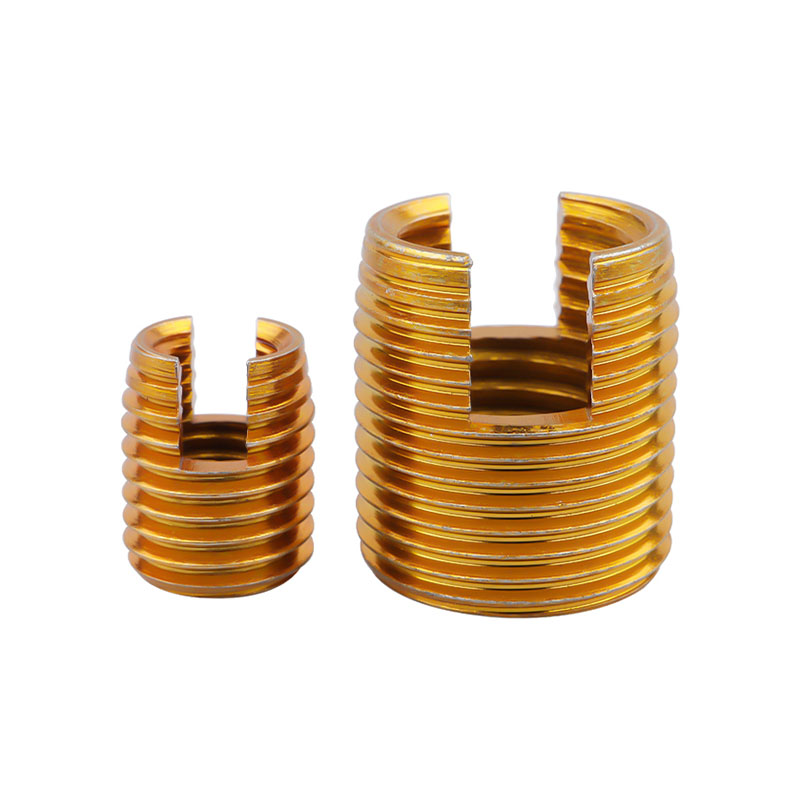 Carbon Steel Self-Tapping Thread Insert for Soft MaterialsCuts threads directly into aluminum or plastic and offers vibration resistance for indoor machinery, furniture, and sheet metal assemblies.View Product →
For threaded joints, specify the strength and ductility combination that matches the failure mode you need to prevent, not the highest tensile value available.
Common Carbon Steel Grades and How They Behave in Threaded Inserts
Grade selection becomes easier when the application is described in terms of load, host material, corrosion exposure, and installation method. AISI 1018 is widely used for general hardware because it forms and welds well. AISI 1045 is common in heat-treated threaded parts and shafts. AISI 1065 and 1080 are used where higher hardness and wear resistance are needed. Free-machining grades such as 12L14 add sulfur to improve chip breaking, but they can reduce weldability and toughness.
| Grade | Key property | Typical use | Thread insert consideration |
|---|---|---|---|
| AISI 1018 | Good ductility and weldability | General hardware, mild structural parts, cold-formed components | Suitable for self-tapping inserts that need to form or cut into softer host materials |
| AISI 1045 | Medium strength with heat treatment response | Shafts, bolts, threaded parts, machinery components | Good balance for higher-load inserts when heat treatment and distortion are controlled |
| AISI 1065 | Higher strength and wear resistance | Springs, cutting tools, wear parts | Useful for wear-resistant inserts, but lower ductility requires careful installation control |
| AISI 1080 | High hardness and strength | Blades, heavy wear parts, high-strength wires | Not ideal for shock-loaded inserts unless tempered and supported by a tough core |
| 12L14 | Free-machining due to sulfur | High-speed machined parts, fittings, small hardware | Good for machined inserts where chip control matters; check corrosion and toughness requirements |
For carbon steel threaded inserts, the grade must be read together with the product form. A self-tapping insert needs a hard cutting edge and a tough body. A wire thread insert made from carbon steel wire needs consistent tensile strength and fatigue resistance. A three-hole threaded insert used in a casting needs stable dimensions and enough hardness to resist pull-out without cracking the host. The same AISI 1045 certificate can support different products only when the manufacturing process is controlled.
Buyers should also ask whether the grade is normalized, annealed, quenched and tempered, or case hardened. These conditions change dimensional stability and installation behavior. A hardened insert may wear better, but it can also chip during installation if the host hole is misaligned. A softer insert may install more easily, but it may not meet torque or pull-out requirements. The purchasing decision should be based on the drawing requirement and the supplier's process capability, not on the grade name alone.
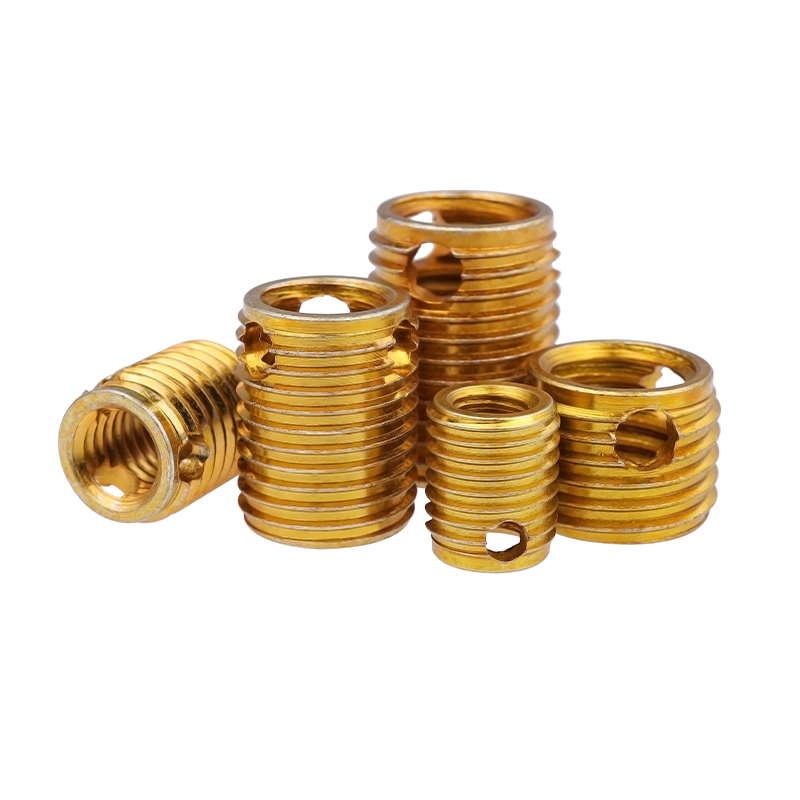 Carbon Steel 3-Hole Thread Insert for Anti-RotationThree positioning holes embed into soft materials to resist rotation and loosening under vibration in industrial equipment, furniture, and chassis assemblies.View Product →
A carbon steel grade is only a starting point; the heat treatment condition and product form decide how that grade performs in a threaded insert.
Physical, Thermal, and Corrosion Properties: The Constraints Engineers Often Miss
Carbon steel has a density of about 7.85 g/cm3 and an elastic modulus near 200 GPa. These values are stable across common grades, so they are rarely the source of disagreement. Thermal expansion is more application-sensitive. Carbon steel expands about 11 to 13 micrometers per meter per degree Celsius over normal service ranges. When a carbon steel insert is used in an aluminum housing, the difference in expansion can change preload and contact stress as the assembly heats and cools.
| Property | Typical value | Practical effect |
|---|---|---|
| Density | 7.85 g/cm3 | Affects weight and inertia in automotive and aerospace assemblies |
| Elastic modulus | About 200 GPa | Controls stiffness and load sharing in a bolted joint |
| Thermal expansion | 11 to 13 µm/m°C | Can change preload when paired with aluminum or stainless steel |
| Thermal conductivity | About 45 to 55 W/mK | Affects heat transfer in engine, transmission, and brake components |
| Melting range | About 1,425 to 1,540°C | Sets a practical ceiling for high-temperature service; oxidation and strength loss occur below melting |
Corrosion is the property that most often decides whether carbon steel is acceptable. Carbon steel rusts in humid air, water, salt spray, and many industrial atmospheres. Zinc plating, phosphate coating, oil, and paint are common protections, but each has limits. A thin zinc layer can be damaged during installation, exposing bare steel. A phosphate coating improves paint adhesion and oil retention but does not provide the same sacrificial protection as zinc.
Galvanic corrosion is a separate risk. When carbon steel is coupled with stainless steel, aluminum, or magnesium in the presence of an electrolyte, the less noble material can corrode faster. In an aluminum housing, a zinc-plated carbon steel insert may be acceptable because zinc acts as a sacrificial coating, but the joint design must still avoid trapped moisture. In a stainless steel assembly, bare carbon steel can become the anode and corrode quickly. Insulation, coating, or material change may be required.
Temperature also changes properties. Carbon steel retains useful strength at moderate temperatures, but above roughly 300°C to 400°C, oxidation and creep become concerns depending on grade and stress. At low temperatures, carbon steel can become more brittle, especially high-carbon grades. For aerospace and railway applications, the service temperature range should be stated explicitly, not assumed from the material name.
Carbon steel strength is predictable, but corrosion and thermal mismatch are the properties that most often cause field failures in threaded assemblies.
Heat Treatment and Surface Treatment: Why Two Carbon Steel Parts with the Same Grade Perform Differently
Two inserts marked AISI 1045 can behave like different materials if one is normalized and the other is quenched and tempered. Normalizing produces a uniform, moderate-strength structure with reasonable ductility. Quenching and tempering can raise strength and hardness, but the tempering temperature must be controlled to avoid brittleness. Case hardening creates a hard surface with a tough core, which is useful for self-tapping inserts that must cut or form threads without cracking.
Stress relief is often overlooked. Machining, cold forming, and thread rolling leave residual stresses that can cause distortion during heat treatment or cracking during installation. A supplier that controls stress relief and fixturing can hold thread tolerances more consistently. That matters because a thread insert is a precision component. A small change in pitch diameter, minor diameter, or coating thickness can change installation torque and pull-out performance.
Surface treatment adds another layer of variation. Electroplated zinc is common for carbon steel threaded inserts and oil plugs. Blue-white zinc and yellow zinc describe different passivation colors, but the functional requirements are coating thickness, adhesion, corrosion hours, and hydrogen embrittlement control. Phosphate coatings are useful when oil retention or paint adhesion matters. Black oxide provides limited corrosion protection and is usually combined with oil.
Plating thickness affects fit. A zinc layer of 5 to 15 micrometers per surface can change the effective thread size. For small threads, this is enough to cause tight assembly or coating damage during installation. The drawing should state whether the coating is measured before or after thread gauging and what allowance is permitted. A supplier that understands these tolerances can prevent field problems that look like material failures but are actually coating and dimension issues.
Hydrogen embrittlement is a specific risk for high-strength carbon steel parts that are electroplated. If the steel is above a certain strength level, hydrogen can enter the surface during plating and cause delayed cracking. Baking after plating is a common control. Buyers of high-strength carbon steel inserts should ask whether the supplier has a baking procedure and how it is verified. This is a process control question, not a grade question.
The same carbon steel grade can pass or fail in service depending on heat treatment, stress relief, coating thickness, and hydrogen embrittlement control.
Application Scenarios and Selection Points for Carbon Steel Threaded Inserts
Carbon steel threaded inserts appear in automotive engine and transmission housings, aerospace assemblies, railway components, and general industrial equipment. The common thread is a parent material that cannot carry the required thread load alone, or a thread that needs repair after wear or stripping. The selection process should start with the host material and the failure mode, not with the insert catalog.
Application scenarios
|
Selection points
|
For soft aluminum, a self-tapping insert can form a mating thread and reduce the risk of galling. For a high-vibration joint, a key-locking or screw-lock design may be more appropriate because it resists rotation. For a repair where the original thread is damaged, a wire thread insert can restore the thread without changing the surrounding boss. For a cast component with limited space, a three-hole threaded insert may provide a stable, low-profile interface.
Self-tapping insert
Cuts or forms its own thread in the host material. Useful in aluminum, magnesium, and soft castings where pre-tapping is difficult or where thread repair is needed.
Wire thread insert
Restores or reinforces a threaded hole with a helical coil. It distributes load over more threads and is common in repair and high-fatigue applications.
Key-locking insert
Uses keys or pins to lock the insert against rotation. Suitable for high-vibration joints and applications where a positive mechanical lock is required.
Three-hole threaded insert
Provides a stable threaded interface in castings and thin-wall sections. The hole pattern supports installation and load distribution in repair and OEM work.
Selection also depends on the installation tool. A self-tapping insert requires a driving tool that controls torque and alignment. A wire thread insert requires a installation tool that does not over-twist the coil. A key-locking insert requires a key seating operation. If the tooling is wrong, the insert may be damaged before it reaches the required depth. Buyers should confirm that the supplier offers matching installation tools and removal tools for the selected insert type.
Start insert selection with the host material and failure mode, then choose the insert type and carbon steel grade that can be installed correctly.
Detailed Comparison: Carbon Steel vs Stainless Steel vs Aluminum for Threaded Connections
Carbon steel is often selected because it offers a good strength-to-cost ratio. Stainless steel offers corrosion resistance and clean appearance but costs more and can gall during assembly. Aluminum is lightweight and easy to machine but has lower strength and a high risk of thread stripping. The comparison should be made at the joint level, not at the material data sheet level.
| Factor | Carbon steel | Stainless steel | Aluminum |
|---|---|---|---|
| Strength | Good to high, depending on carbon content and heat treatment | Moderate to high, depending on grade | Low to moderate |
| Corrosion resistance | Low without coating; improved by zinc, phosphate, or paint | High in many environments; can still corrode in chlorides | Moderate; forms oxide layer but can corrode in some environments |
| Weight | Relatively heavy | Relatively heavy | Light |
| Cost | Generally lower | Higher | Moderate |
| Machinability | Good, especially free-machining grades | Moderate; work hardening and galling can be issues | Good |
| Thread life in soft hosts | Good when specified with the right insert design | Good, but galling risk with stainless mating threads | Poor without inserts |
| Galvanic risk | Can be anodic when coupled with stainless or aluminum | Usually cathodic to carbon steel and aluminum | Can be anodic or cathodic depending on the couple |
The practical conclusion is that carbon steel is often the best choice for strength and cost when the environment is controlled and the coating is adequate. Stainless steel is preferable when corrosion resistance is the dominant requirement and the budget allows it. Aluminum is rarely suitable for a highly loaded threaded joint without an insert, because the threads can strip under repeated assembly.
In an aluminum housing, a carbon steel insert can be a good solution because the insert provides a stronger thread interface. However, the galvanic couple between carbon steel and aluminum must be managed. Zinc plating can act as a sacrificial layer, but coating damage or trapped water can still cause corrosion. Sealants, dry assembly, and drainage paths may be needed in exposed applications.
When carbon steel is paired with stainless steel, the carbon steel is usually the anode. That means the carbon steel insert or plug can corrode preferentially if moisture is present. For outdoor or washdown equipment, a stainless steel insert may be more appropriate, or the carbon steel part should be isolated with a coating or sealant. The decision should be based on the electrolyte exposure, not only on the material cost.
Carbon steel wins on strength and cost in controlled environments, but stainless steel or a protective coating is needed when corrosion is the dominant risk.
Maintenance, Inspection, and Failure Prevention for Carbon Steel Components
Carbon steel threaded components need inspection before and during service. Look for white or red rust, coating damage, thread wear, crushed threads, and loose joints. In automotive and railway maintenance, a thread that looks intact may have lost preload due to vibration, thermal cycling, or relaxation. Torque checks should be performed with a calibrated tool and the specified lubrication condition.
Cleaning matters. Acidic or chloride-containing cleaners can attack zinc coatings and bare steel. After cleaning, dry the joint and reapply the specified protective oil or coating if required. For oil plugs, the sealing surface and thread condition are as important as the material grade. A carbon steel oil plug with damaged threads can leak even if the steel properties are correct.
- Inspect coating coverage on the first few threads and the sealing face.
- Check for galvanic corrosion where carbon steel contacts aluminum or stainless steel.
- Verify that installation tools are not damaging the insert during driving.
- Record installation torque and depth for critical assemblies.
- Replace inserts that show cracks, severe wear, or loss of locking function.
- Store carbon steel parts in a dry area to prevent pre-installation rust.
Failure prevention starts with the drawing. If the drawing does not specify coating thickness, heat treatment condition, and acceptance criteria, the supplier may deliver parts that meet the grade but not the application. A carbon steel insert that is too hard may crack; one that is too soft may wear or deform. A coating that is too thick may prevent proper thread engagement; one that is too thin may corrode early.
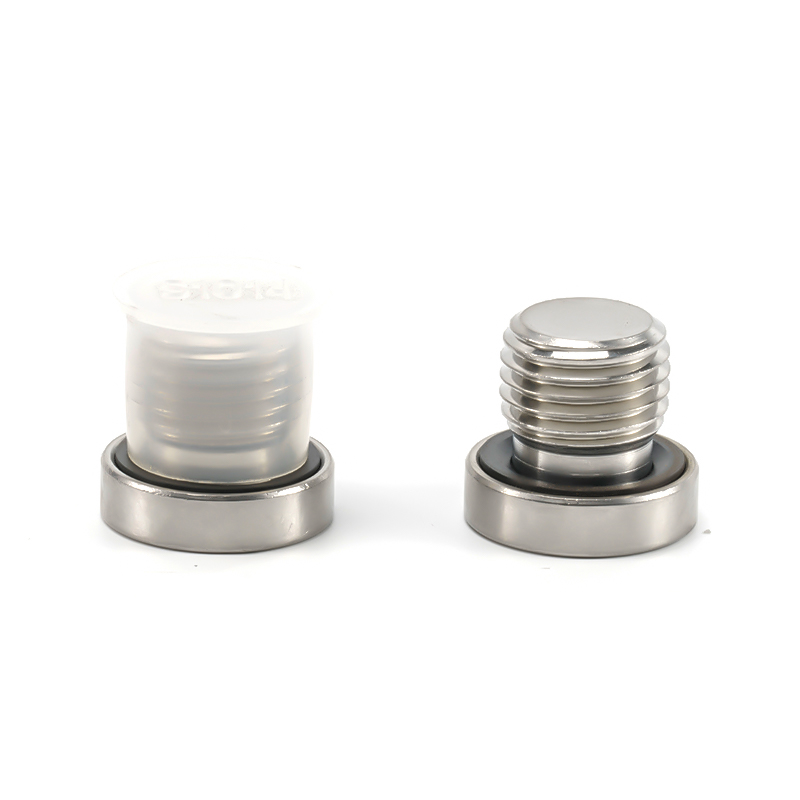 Carbon Steel Oil Plug for Sealing ApplicationsProvides a carbon steel sealing component for engines, transmissions, machinery, and high-pressure oil or gas systems where leakage prevention matters.View Product →
Most carbon steel field failures are preventable through coating inspection, torque control, and drawing requirements that state heat treatment and dimensional tolerances.
Buying Carbon Steel Threaded Inserts from a Manufacturer: Specifications, Tolerances, and Supplier Checks
Purchasing carbon steel threaded inserts is not a catalog-only decision. The buyer should provide the host material, thread size, required proof load, service temperature, corrosion exposure, installation method, and inspection standard. The manufacturer should return a documented proposal with grade, heat treatment, coating, dimensional tolerances, and acceptance criteria. A supplier that cannot explain these items is a procurement risk.
Ask for a chemical composition report and a mechanical property report for the actual production lot. The certificate should show carbon, manganese, silicon, sulfur, and phosphorus where relevant. Mechanical testing should cover tensile strength, yield strength, elongation, and hardness as required by the drawing or standard. For critical automotive and aerospace parts, traceability from heat number to finished lot is expected.
- Confirm the carbon steel grade and heat treatment condition.
- Check coating type, thickness, adhesion, and corrosion test results.
- Review thread gauging, minor diameter, and installation torque data.
- Verify hydrogen embrittlement controls for high-strength electroplated parts.
- Confirm installation tool compatibility and removal tool availability.
- Review packaging, rust prevention, and lot identification.
- Check whether the supplier can support repeat orders and consistent lead times.
Even a wholesaler should be able to identify the original manufacturer and provide material certificates. If the supply chain is opaque, the buyer cannot verify that the carbon steel material properties in the quotation match the delivered parts. For safety-related assemblies, this is not acceptable. The purchase order should require lot traceability and a certificate of conformity.
Dimensional tolerances deserve special attention. Thread inserts are small components with tight pitch and minor diameter requirements. A few micrometers of coating can change installation torque. A small burr can damage the host thread. A supplier with in-house machining, heat treatment oversight, and thread gauging can control these variables better than a trader that only repackages parts. The buyer should ask how the supplier controls distortion after heat treatment and how coating thickness is measured.
A qualified carbon steel insert supplier must document grade, heat treatment, coating, tolerances, and traceability, because the grade name alone does not prove the delivered properties.
Frequently Asked Questions About Carbon Steel Material Properties
What do carbon steel material properties mean for thread strength?They define how much load the insert can carry before it deforms or cracks, and how much elongation it has before failure. Thread strength also depends on the host material, thread engagement, and installation quality. A high-strength insert can still fail if the parent thread strips first. |
Does higher carbon content always make a better thread insert?No. Higher carbon increases strength and hardness, but it reduces ductility and toughness. A very hard insert may crack during installation or vibration. The best choice depends on the failure mode, host material, and installation method. |
Can carbon steel threaded inserts be used in aluminum?Yes, and they are often used to reinforce or repair aluminum threads. The insert must be selected for the aluminum grade, wall thickness, and required pull-out load. Zinc plating and installation torque control help prevent galvanic and mechanical damage. |
Is carbon steel suitable for outdoor or wet environments?Bare carbon steel is not suitable for sustained moisture or salt exposure. Zinc plating, phosphate plus oil, paint, or a material change to stainless steel may be required. The joint design should also avoid trapped water and galvanic couples. |
How does zinc plating affect thread fit?Plating adds thickness to the thread surface, typically several micrometers per side. On small threads, this can reduce clearance and change installation torque. The drawing should state coating thickness limits and whether gauging is performed before or after plating. |
What is the difference between 1018 and 1045 carbon steel?AISI 1018 is low-carbon steel with good formability and weldability. AISI 1045 is medium-carbon steel that can be heat treated to higher strength. The 1045 part is stronger but less forgiving in forming and welding. |
Can carbon steel replace stainless steel in a threaded application?It can when the environment is controlled and the carbon steel part is properly coated. It should not be used as a direct replacement in wet, salty, or chemical exposure without a corrosion assessment. Galvanic corrosion and maintenance intervals must be considered. |
Use carbon steel material properties to match the insert to the host material and environment, and verify the delivered lot against the drawing.
Where to Go Next
If you are comparing carbon steel grades for a threaded insert, start with the product family and the host material. The carbon steel threaded insert range shows the available self-tapping, three-hole, and related configurations for different assembly needs. The manufacturing background explains the company's quality control, production capacity, and traceability approach for automotive, aerospace, and railway customers.
Carbon steel threaded insertsReview product families, materials, coatings, and installation options for thread reinforcement and repair. |
Manufacturing backgroundCheck the factory profile, quality management approach, and supply capability for threaded connection products. |
Choose the insert family first, then confirm the carbon steel grade, heat treatment, coating, and supplier documentation against the joint requirement.


