

 Français
 Español
 Deutsch


Content
- 1 What the Carbon Steel Modulus Actually Is
- 2 Why Carbon Content Barely Moves the Number
- 3 Comparing Carbon Steel Stiffness With Other Materials
- 4 Stiffness, Strength and Hardness Are Not Interchangeable
- 5 Where the Carbon Steel Modulus Matters in Threaded Insert Work
- 6 Values by Grade and Product Form
- 7 Selection and Purchasing Checklist
- 8 How the Number Is Verified
- 9 Frequently Asked Questions
- 9.1 What is the carbon steel modulus of elasticity?
- 9.2 Does higher carbon content raise the modulus?
- 9.3 Is Young's modulus the same as the modulus of elasticity?
- 9.4 Does heat treatment change the modulus of carbon steel?
- 9.5 How does temperature affect the modulus?
- 9.6 Does a higher modulus insert increase pull-out strength?
- 10 Related Pages
A drawing calls for an M10 bolt into a die-cast aluminium housing with a 12 mm wall. The bolt is fine; the thread is not, so a carbon steel thread insert goes into the callout. At the design review someone asks the question that quietly decides insert wall thickness, engagement depth and half the tolerance stack: which carbon steel modulus should we use for the insert, and does the grade actually matter?
Short answer: use 200 GPa for plain carbon steel, every time. That is 29,000 ksi, or 200,000 N/mm2, and it holds from 1018 through 1095 with only a few percent of scatter. Carbon content, rolling direction and heat treatment move the elastic modulus far less than they move yield strength, which can triple across the same grade range.
The sections below set out the accepted values, explain why the number is so stable, compare carbon steel with the materials it usually sits beside in a bracket or a housing, and then narrow to the case that matters most on a threaded-insert shop floor: a hardened steel insert carrying a bolt load inside a softer parent material.
Stiffness belongs to the crystal lattice, not to the heat-treat furnace. Pick the grade for strength, wear and machinability, and the modulus will arrive at roughly 200 GPa regardless.
What the Carbon Steel Modulus Actually Is
The modulus of elasticity, also called Young's modulus or tensile modulus, is the slope of the straight portion of a stress-strain curve. It answers one question only: how much stress does it take to produce a given elastic strain. For carbon steel the slope is steep. A one-metre bar with a 100 mm2 cross-section, pulled with 10 kN, sees 100 MPa of stress and stretches 0.5 mm; the same bar in aluminium would stretch about 1.45 mm.
Because the value is quoted in several unit systems, most drawing-office arguments are really conversion arguments. One gigapascal equals 145.04 ksi, so 200 GPa lands on 29,000 ksi, which is 29 million psi, which is 200,000 N/mm2. If a supplier certificate states 205 GPa, that is 29,700 ksi, and nothing on the drawing needs to change.
| Property | Typical value, metric | Typical value, imperial |
|---|---|---|
| Young's modulus, E | 190 to 210 GPa, usually 200 to 207 GPa | 27,500 to 30,500 ksi, usually 29,000 ksi |
| Shear modulus, G | 76 to 82 GPa | 11,000 to 11,900 ksi |
| Bulk modulus, K | 140 to 170 GPa | 20,300 to 24,700 ksi |
| Poisson's ratio | 0.27 to 0.30 | 0.27 to 0.30 |
| Density | 7.75 to 7.87 g/cm3 | 0.280 to 0.284 lb/in3 |
Shear modulus and Young's modulus are linked by G = E / (2(1 + v)). With E of 200 GPa and Poisson's ratio of 0.29, that gives 77.5 GPa, close to the 79 to 80 GPa quoted in most steel handbooks. Any supplier who reports a shear modulus wildly outside that relationship is quoting a different material or a different test.
The modulus describes stiffness in the elastic range only. It tells you nothing about when the part will yield, and nothing about its fatigue life.
Why Carbon Content Barely Moves the Number
Elastic strain is a small, reversible stretching of the atomic bonds between iron atoms. Those bonds are set by the crystal structure, not by how much pearlite, bainite or martensite sits at the grain boundaries. Raising carbon from 0.10% to 0.80% changes the volume fraction of cementite dramatically, and that is why yield strength climbs from roughly 370 MPa to 600 MPa and hardness climbs with it. The bond stiffness barely notices.
Heat treatment is the same story. Quenching and tempering 4140 takes yield strength past 650 MPa and hardness past 300 HB, while the modulus moves from about 200 GPa to about 205 GPa. That 2.5% is close to the repeatability of a routine tensile test, which is why no designer sizes a bracket on the difference between annealed and quenched stiffness.
Three effects do shift the number enough to matter:
- Alloying. Chromium, nickel and molybdenum add a few gigapascals. Austenitic stainless steels such as 304 and 316 sit lower, at 193 to 200 GPa, because the face-centred cubic lattice is slightly less stiff than body-centred cubic iron.
- Cold work. Drawing or rolling can raise the modulus by 1% to 3% along the working direction, and the effect is directional. It is measurable, rarely design-relevant.
- Temperature. Modulus falls as temperature rises, by roughly 5% at 200 C and 15% to 20% at 400 C. A carbon steel insert in an engine or exhaust application should be checked at the operating temperature, not at 20 C.
Cast versus wrought makes a difference in strength and defect population, but not in modulus. Grey cast iron is the exception people remember, and it is not a modulus exception at all: the flake graphite acts as internal voids, so the measured stiffness of the casting drops to 100 to 170 GPa depending on graphite shape and volume.
Specify carbon content for strength, wear resistance and machinability. Specify temperature and section geometry when deflection is the real design driver.
Comparing Carbon Steel Stiffness With Other Materials
A number in a table is easy to read and hard to feel. Placing carbon steel next to the materials it competes with in a housing, bracket or insert application makes the magnitude obvious. The values below are room-temperature tensile moduli drawn from standard handbook data and mill certificates, rounded to whole gigapascals. The bars share one scale, so bar length is directly proportional to stiffness. Read the chart for order of magnitude and for ratios between materials, not for the last gigapascal. Tolerances and heat-to-heat variation are handled later in the verification section.
| Material | Relative stiffness | E, GPa |
|---|---|---|
| Carbon steel | 200 | |
| Stainless steel 304 | 193 | |
| Grey cast iron | 130 | |
| Copper | 117 | |
| Brass | 110 | |
| Titanium Ti-6Al-4V | 110 | |
| Aluminium 6061-T6 | 69 | |
| Magnesium AZ31 | 45 |
The carbon steel bar sets the reference at 200 GPa, and the first thing the chart shows is how little separates it from stainless. A 304 insert is about 3% less stiff than a carbon steel one, which means corrosion resistance is not being bought with a meaningful loss of rigidity. That single observation resolves a large share of material-substitution debates in food, marine and medical assemblies.
Grey cast iron is the next surprise. At 100 to 170 GPa it is roughly half to two-thirds as stiff as steel, and the spread is wide because graphite morphology varies between flake, compacted and nodular grades. A designer who assumes a cast housing behaves like a steel one will under-predict deflection in the housing and over-predict the load the insert must carry.
Aluminium is the comparison that matters most in threaded-insert work. At 69 GPa it is about 2.9 times softer than carbon steel, so in a bolted joint the steel insert and the steel bolt dominate the stiffness of the load path while the aluminium thread flank deforms first. That is not a defect; it is the reason inserts exist. The insert spreads bearing load over a larger shear area in a material that cannot carry concentrated thread loads on its own.
Titanium sits near 110 GPa, roughly half of steel, but its density of 4.5 g/cm3 restores the balance. Copper and brass land between 100 and 125 GPa and are common in bushings and electrical hardware where conductivity, not stiffness, is the selection driver. Magnesium, at 45 GPa, is the outlier in the other direction and needs generous thread engagement or a steel insert in almost every structural joint.
Dividing modulus by density gives specific stiffness, and the result is a useful corrective to intuition. Carbon steel returns about 25.5 GPa per g/cm3, aluminium about 25.6, and titanium about 24.4. On a per-kilogram basis the three are nearly tied, so a stiffness-driven design that switches from steel to aluminium gains nothing in mass efficiency unless the geometry changes at the same time.
The chart also explains why deflection problems are rarely solved by changing grade. Doubling the section depth raises the second moment of area by a factor of eight, while moving from 1018 to 4140 changes E by two or three percent. Geometry wins every time, and it is cheaper.
Across the materials shown, stiffness spans a factor of about 4.4, while yield strength spans a factor of 20 or more. Modulus is the stable property; strength is the variable one.
Stiffness, Strength and Hardness Are Not Interchangeable
A common purchasing mistake is to upgrade the steel grade in the belief that it will reduce deflection or stop a joint loosening. It will not. The table below shows what actually changes when the grade changes.
| Grade | Modulus, E | Yield strength | Ultimate strength | Typical use |
|---|---|---|---|---|
| 1018 | 200 GPa | 370 MPa | 440 MPa | General inserts, light load, good weldability |
| 1045 | 200 to 206 GPa | 530 MPa | 630 MPa | Shafts, studs, moderate wear |
| 1144 | 200 GPa | 620 MPa | 745 MPa | High-strength studs without heat treatment |
| 4140, quenched and tempered | 205 GPa | 655 MPa | 1020 MPa | High preload, aerospace fittings |
| 12L14 | 200 GPa | 340 MPa | 480 MPa | High-speed machining of small parts |
Read the second column against the third and the message is plain. From 1018 to quenched 4140 the modulus rises about 2.5%, while yield strength rises about 77% and ultimate strength more than doubles. Hardness, wear resistance and fatigue behaviour follow strength. Stiffness does not.
There is one indirect link worth knowing. Elastic strain at yield equals yield strength divided by modulus. For a 355 MPa steel that is 0.18%; for a 655 MPa steel it is 0.33%. The stronger steel deforms further before it yields, so a stiff joint with a high-strength fastener may need a longer bolt or a different preload strategy to keep clamp load stable under cycling.
If the complaint is deflection, change geometry. If the complaint is stripping, galling or fatigue, change grade and heat treatment.
Where the Carbon Steel Modulus Matters in Threaded Insert Work
In a bolted joint through an aluminium housing, the bolt, the insert and the parent material form a series load path. Because the steel insert is roughly three times stiffer than the aluminium around it, it attracts the bolt bearing load and distributes it over more thread turns than a bare aluminium thread could sustain. The insert is not there to be strong in isolation; it is there to convert a concentrated, poorly supported load into a distributed one.
It is worth separating two failure modes that designers often merge. Pull-out strength depends on the shear area of the parent material, the external thread geometry and the shear strength of the housing alloy, not on the insert's modulus. Thread stripping inside the insert depends on the internal thread engagement and the bolt material. Preload retention and joint stiffness depend on modulus, and that is where a 200 GPa insert earns its place.
Thermal mismatch is the second consequence. Carbon steel expands about 11.5 to 13 micrometres per metre per degree C, aluminium about 23. Over a 20 mm aluminium boss with a steel insert, a 100 C rise produces roughly 0.02 mm of differential movement. In a short joint that is absorbed by elastic deformation; in a long stack it shows up as lost preload or as fretting at the thread flank.
Engagement rules follow from the same reasoning. As a working guide, plan for 1.5 to 2 times nominal diameter of engagement in aluminium and 1.0 to 1.5 times in steel, then confirm by pull-out test rather than by calculation alone. A carbon steel insert with a wall thickness of 0.8 to 1.2 mm in an M6 to M10 size is normal; thinner walls shift failure into the insert, thicker walls may split a thin boss.
For assemblies built around these rules, the carbon steel threaded insert range covers self-tapping, three-hole and key-locking styles, each aimed at a different parent material and service condition.
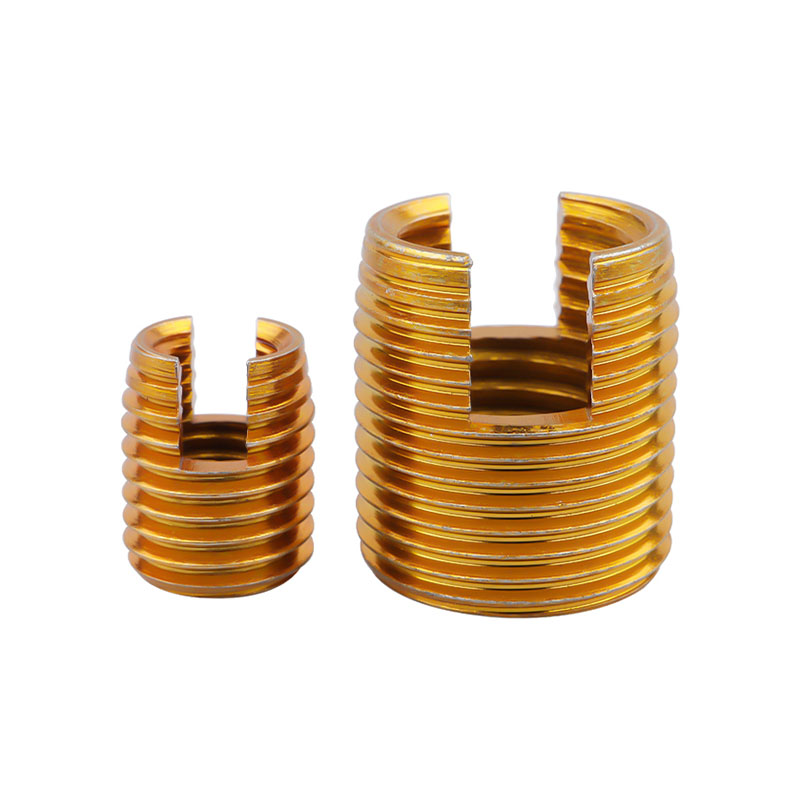 Carbon Steel Self-Tapping Thread InsertEconomical carbon steel insert for dry indoor assemblies, cutting into aluminum or plastic to reinforce threads and resist stripping; optional zinc plating.View Product →
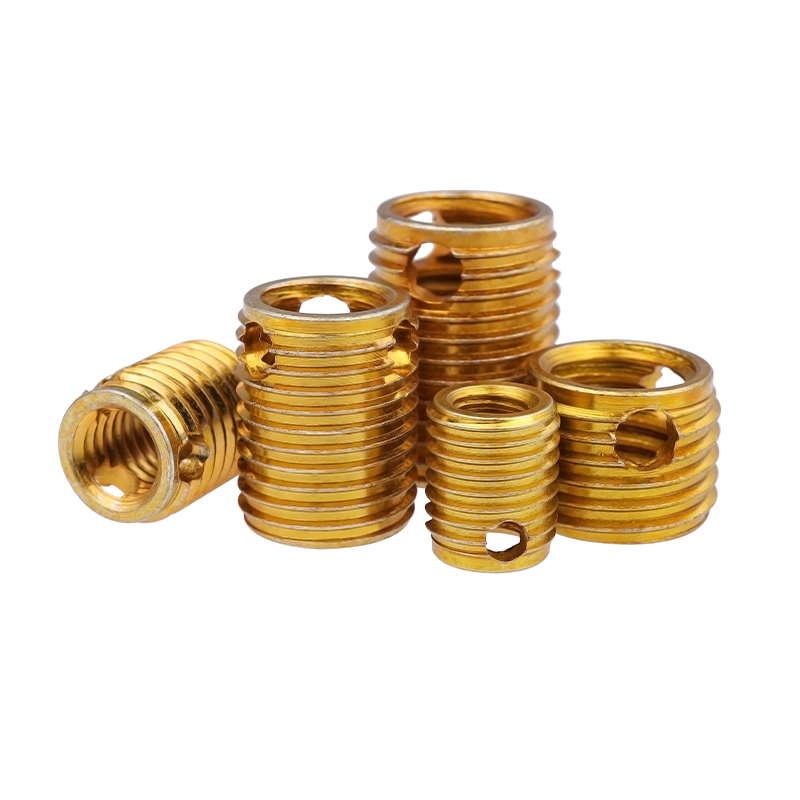 Carbon Steel Three-Hole Thread InsertAnti-rotation carbon steel insert with three positioning holes that lock into soft materials, suited to vibration-prone industrial assemblies and offering optional zinc coating.View Product →
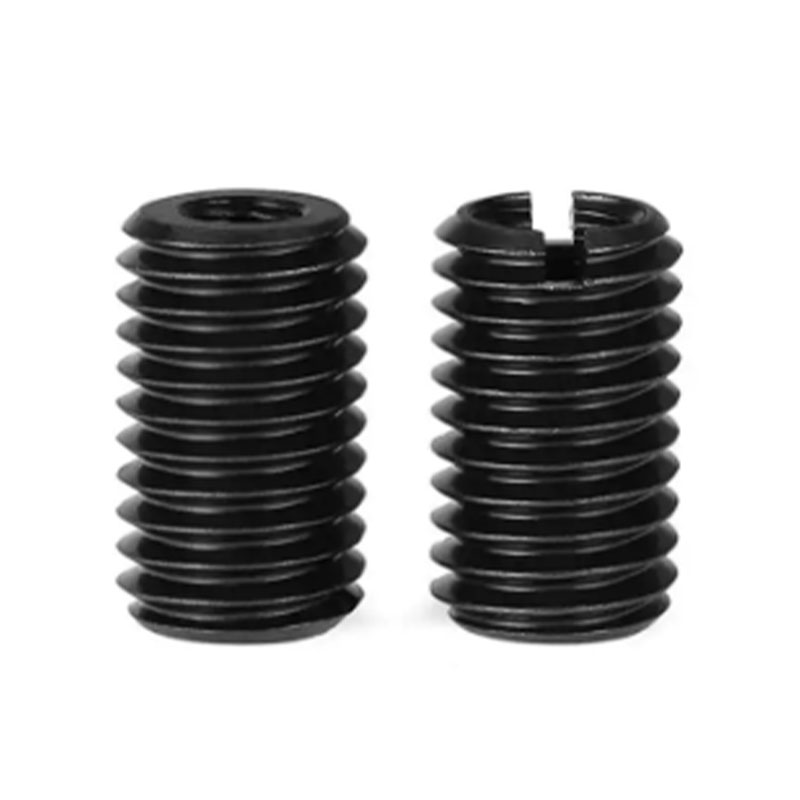 Carbon Steel Internal-external Thread Conversion NutCarbon steel adapter with male and female threads for converting between metric, imperial and unified standards in machinery, automotive and other industrial connections.View Product →
Modulus decides how load is shared, not how much load can be carried. Pull-out and strip resistance come from shear area and material strength.
Values by Grade and Product Form
Bar stock, wire, tube and cold-formed insert bodies all report the same modulus within a few percent, because the property is set by composition and lattice rather than by the forming route. What changes between product forms is strength, surface finish, residual stress and dimensional tolerance, and those are the items to put on a purchase order.
Wire thread inserts are normally made from cold-drawn austenitic stainless wire, which lands at 193 to 200 GPa, slightly below carbon steel but well above any aluminium or magnesium housing. Self-tapping inserts are commonly carbon steel with a zinc or zinc-nickel coating, or 303 and 304 stainless where corrosion resistance dominates. Key-locking inserts are usually made from a heat-treatable grade so the keys can be driven without deforming the body.
If a drawing specifies only "steel", ask which property is being controlled. For stiffness, any plain carbon grade will do. For preload, plating friction and galling behaviour matter more than modulus. For corrosion, the coating system decides life, not E.
Two insert suppliers quoting 200 GPa are quoting the same physics. The real difference sits in thread tolerance, plating thickness, hardness and lot traceability.
Selection and Purchasing Checklist
The technical side and the commercial side look at the same insert from different angles. Both need to agree before a lot is released.
Design check
|
Supplier check
|
On the commercial side, a manufacturer with in-house machining can usually hold tighter control over thread concentricity and plating thickness than a trader sourcing from several mills. For repeat orders, ask for the last three lots of dimensional data rather than a single sample report.
Modulus will never be the reason a lot is rejected. Thread tolerance, hardness and coating thickness will be, so put the inspection budget there.
How the Number Is Verified
Room-temperature tensile testing to ISO 6892-1 or ASTM E8 is the reference method. A specimen is pulled with an extensometer or a crosshead-compensated setup, and the slope is taken between 10% and 40% of the expected yield point. Modern machines quote modulus within about 1% for a well-prepared specimen, and interlaboratory scatter of 3% to 5% is normal.
For small inserts that cannot be machined into a standard specimen, suppliers often rely on mill certificates for the raw bar or wire, and verify the finished part by hardness, torque-to-failure and pull-out testing instead. That is a sound approach: hardness tracks strength, and torque testing tracks the behaviour that matters in assembly.
When a supplier publishes a modulus, check the temperature and the standard behind it. A room-temperature 200 GPa figure is not wrong for a 350 C application, but it is 15% optimistic, and that error propagates straight into any preload calculation.
Ask for the test temperature, the standard and the specimen orientation. A bare modulus figure without those three details is a marketing number.
Frequently Asked Questions
What is the carbon steel modulus of elasticity?For plain carbon steel the accepted value is about 200 GPa, equivalent to 29,000 ksi or 200,000 N/mm2. Most grades fall between 190 and 210 GPa, and the 200 to 207 GPa band covers ordinary structural and free-machining grades. |
Does higher carbon content raise the modulus?Only marginally, by a few gigapascals at most. Carbon raises yield strength and hardness substantially, but the elastic stiffness of the iron lattice is largely unaffected, which is why 1018 and 1095 behave almost identically under small elastic loads. |
Is Young's modulus the same as the modulus of elasticity?Yes, for an isotropic polycrystalline steel the terms are interchangeable, and tensile modulus is used as well. Shear modulus and bulk modulus are different constants and take lower and higher values respectively, linked through Poisson's ratio. |
Does heat treatment change the modulus of carbon steel?It changes it by roughly 2% to 3% between the annealed and quenched-and-tempered condition, which is close to test repeatability. Strength and hardness change far more, so heat treatment should be specified for those properties, not for stiffness. |
How does temperature affect the modulus?It falls as temperature rises, by about 5% at 200 C and 15% to 20% at 400 C. For inserts in engine, exhaust or brake assemblies, the design calculation should use the modulus at operating temperature rather than the 20 C handbook value. |
Does a higher modulus insert increase pull-out strength?Not directly. Pull-out strength is governed by the shear area of the parent material, thread geometry and the parent alloy's shear strength. The insert modulus affects load sharing, preload retention and thermal behaviour, which is a different part of the design problem. |
Related Pages
Two pages on this site extend the points covered above: the material range behind the numbers, and the mechanics of thread strengthening in soft parent materials.
| Carbon steel threaded inserts, grades and finishes | How metal thread inserts improve thread strength in soft materials |
Treat 200 GPa as a fixed input, size the insert for the parent material, and spend the remaining engineering effort on thread tolerance, hardness and coating control. That combination is what separates a joint that holds preload for a decade from one that loosens in the first service cycle.
One modulus, many grades: get the geometry and the parent material right, and the carbon steel modulus will look after itself.


